Showing posts with label Dungeons and Dragons. Show all posts

DCC Magic for the rest of us.


I love the chaos of magic in Dungeon Crawl Classics, but if I look up another spell table I'll go insane. Here's a simple version for you folks at home.

To cast spells, a wizard must roll a spell check. Roll a d20, add your Intelligence modifier and your level as a Wizard, and try to beat the spells difficulty. That's 12 or better for a level 1 spell, 14 or better for a level 2 spell, 16 or better for level 3, and so on.

If you succeed, you cast the spell and keep it. If you fail, you lose the spell for the day. On a natural 20, you get some incredible super version of the spell. On a natural 1, the spell backfires hilariously and you become hideously corrupted. The DM should just make these critical spell effects and mutations up on the spot, taking into account the context. DCC has plenty of examples, and you can use The Benefactors for inspiration.

Clerics are slightly different. First, they add their Wisdom/Personality modifier to spell checks instead of Intelligence. Second, when they fail, they incur Disfavor from their god instead of losing the spell. Disfavour adds 1 to their critical fail chance for spells. When they inevitably end up critically failing a spell, their god curses them. Make up some terrible fate based on their god.

A cleric spends all day pissing off her god, and all night trying to patch things back up again. Clerics can get rid of disfavor by pleasing their god with sacrifices and the like, and all Disfavor disappears if you spend your normal 9+ hour rest in deep meditation and prayer.
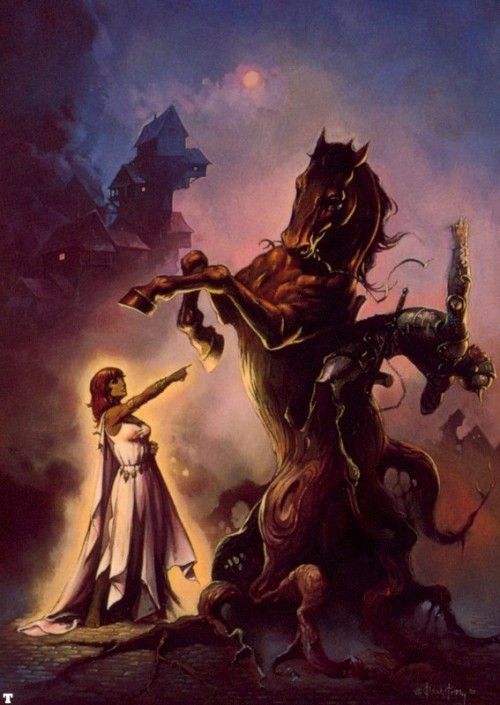
— Ken Kelly
The Elemental

Magic-users can improvise special effects for a spell, in the same way that a fighter can improvise exciting ways to stab someone. Say, set the ground on fire instead of sending out a Fireball, using Turn Unholy to destroy demonic artifacts or Sanctuary to stop monsters from entering a room. Anything that fits in with the general feel of the spell is fine. Just raise the spells difficulty by 2, 4, 6 or more, based on how hard the thing they're trying to do is. EDIT: or you could use this called shot mechanic. Raise their critical fail chance and lower their critical hit chance. The crazier the thing they're trying to do with it, the more likely it is to misfire.

This is my favorite idea on this page. DCC has a lot of spells like "Force Manipulation", which could give you an invisible weapon, platform, blockade or manservant, depending on your roll. The variability is great, but having it depend on a roll sucks. This rule makes normal spells as free-form and weird as they are in DCC and gives power to player creativity instead of forcing them to look shit up in a book.(!!!)


All spellcasters have friends in high places. Wizards can call on the despicable beasts they've made obscene pacts with, and Clerics can call on their Gods. If they want to ask their pals for aid, have them roll a spell check as usual. They can ask for a favour as good as the roll allows; beat 5, 10, 15 or 20, where 5 is a minor boon and 20 is apocalyptic. Wizards will of course have to satisfy some dark price later on (again, see The Benefactors). For Clerics, asking their god for Divine Intervention incurs +10 to Disfavor.

(This means that clerics will generally ask their god for help at least once a day, while Wizards will avoid getting in debt to their Patrons unless they can possibly help it, and then wish they hadn't for the rest of the game.)

You can use this system to DCC-ify spells from other versions of D&D. Vancian spellcasters should get all their spells, instead of memorizing a set number of them per day. This may seem like a lot, but that high failure rate means they'll lose plenty of them without casting them. Clerics and wizards should both start with about 4 spells and get one more per level.

On adding your level to spell checks: in DCC, level 10 is the max. Adding 11-20 to a spell check makes the whole thing a little redundant, so you might want to consider giving out that +1 to spell checks every second level if your system goes up to 20.

Jack McNamee's 10-Second System


I've been playing X-Com lately. You control 14 dudes as they die, panic, succumb to alien mind control and turn into zombies. At the end of a mission you level up the survivors and buy another crateload of rookies. Death is constant and hard to anticipate, so a lot of the strategy revolves around sending in the cannon-fodder rookies to protect the guys you care about.

It's interesting, because as far as I can tell early D&D worked the same way. A lot of the traps in the DMG seem totally ridiculous for the current fashion of ~4 PC's. Save or Die effects, level drain, diseases - Matt's poor PC died to Rotgrubs in a single turn, before he had any way to tell what was happening or how to stop it. These things only really make sense if you have 10+ PC's, with some hirelings for good measure.

(You'll have to excuse me if I'm reiterating stuff everybody knows. D&D is still a strange new land to me.)

Creating 10 normal characters and trying to keep track of the results would take hours and drive me insane. So, here's an experiment: Jack McNamee's 10 Second System (Matt helped).

--------
Roll one d6 for each starting ability score, then roll an occupation and starting equipment (You can use this DCC character generator for those). Your starting character is finished.

Dret thiefton turned out to be only average at thief skills. His parents will be shattered.

Here's what the scores mean.

Strength: The weapons you can use. Whenever the PC's find a weapon, rate it out of ten; you need that much strength to wield it. Bonuses to damage and to-hit are inherent in the weapons you find, rather than something you earn as you level up. Roll under it on a d10 for strength checks.

Constitution: The hit dice you get whenever you level up. Roll under it for fort saves.

Dexterity: Skill checks and reflex saves. Whenever a PC needs to make a skill check, rate the task: 5 for trivial tasks, 10 for normal tasks, 15 for hard and 20 for impossible. Your dexterity shows which dice you roll for it; d6 to d20+10. At 1 dex, you cannot perform any kind of skill checks.

You can learn skills from expert thieves. If you haven't been trained in a skill, use 1 less dex when rolling for it. If Dret Thiefton has 3 dex, he'll roll a d6 instead of a d10 for any skill he hasn't trained in.

You can use any skill list you want, or just use the DCC list: Backstab, Sneak, Hide, Pickpocket, Climb, Locks, Find traps, Disable traps, Forge, Disguise, Read Languages, Poison, Cast spell from scroll.

Intelligence: Which spells you can learn, and will saves. Whenever the PC's find a spell, rate it out of ten; you need that much intelligence to cast it.

Intelligence applies to both Wizard Spells and Cleric Spells. You go to a wizard to learn spells from the Wizard list, and a Cleric to learn spells from the Cleric list. They hate each other, and they'll want you to become one of them before they'll teach you the better spells. You could obviously cheat them to learn both.

Wisdom: The number of spells you can hold in your brain at once. Vancian rules. Roll under for Perception checks.

Charisma: Which Hirelings you can get. Hirelings can be level 1 to 10; that's how much charisma you need to hire them. At 5 Cha, you can hire level 5 guys. High level hirelings will also have better equipment, and may know some skills or spells. Roll under it for a morale check to stop your hirelings panicking or stabbing you in the back.

Every time you level up, you get one hit dice of HP and one extra point of ability score to allocate wherever you want. Max level is 10.

The system assumes every player will have 2-4 PC's. You get 2-4 new PC's when the last PC from your old batch dies - until then you have to rely on hirelings to restock.
-------

So, most of the traditional leveling up choices occur in the world. You have to find spells and skills, instead of being abstractly given those things when you level up. This is partially inspired by the old D&D ideas to that effect, and partially inspired by the way Dark Souls and X-Com work. Your PC is defined by the things they have, and their stats define the things they can have.

It's fast as lightning and completely classless. It's not going to be for everyone. I'll try running it on Monday, I'm excited to see if it works. Tell me what you think in the comments..

Critical fail


D&D is a game where everyone - no matter how good they are, or how much they train, or what dark powers they control - has a 5% chance of hitting themselves in the face.

(Or throwing their weapon across the room, or flailing wildly and stabbing a friend, or tripping over and lying on their back like a turtle, unable to get up.)

I assume everybody else must already know that D&D is a cross between Conan the Barbarian and The Three Stooges, but it came as a big surprise to me. No-one ever mentioned this undercurrent of Vaudeville. It's the one big element of D&D that you can't get from Appendix N: The omnipresent terror of quick death combined with hilarious pratfalls. Watching your fighter slip over and get impaled in a pit of spikes is somehow both horrible and hilarious.

It would be possible to remove the slapstick, with a bit of work. Instead of Stealth Checks, for example, thieves could get better at stealth by slowly going up a table like this:


Silent
Hidden
Silent walking on soft surfaces: grass, dirt
Invisible in complete darkness
Silent running on soft surfaces
Invisible in moonlit darkness
Silent walking on hard surfaces: Wood
Invisible in shadows
Silent running on hard surfaces
Invisible in low-light
Silent walking on loud surfaces: Metal, Gravel
Invisible in overcast daylight


I understand that 5e has tried to eliminate hilarious failures by giving the fighter a minimum of 3 damage, no matter what he rolled. This stuff is very sensible. In real life you slowly get better, rather than getting a smaller chance of failing. It makes sense that fighters don't hit themselves in the face 5% of the time, it makes sense that professional thieves aren't always coughing and giving away their position, it fits into the source material to make everyone into competent professionals who do not fail. 

After making this table, though, I realised I'd never use it. Slapstick isn't something anyone would ever imagine adding to fantasy, it's been quietly ignored in all D&D licensed comics, books and movies, it makes no sense - and it works. The massive infusion of humour and unpredictability it adds is totally vital to RPG's as I play them.