Showing posts with label Magic. Show all posts

Dogs and Magic

I've made these spell cards to use instead of rolling on a table and writing down the result. At level 1 you draw Read Magic and 3 other spells at random from the deck. This means that all the level 1 wizards in the same group will have different spells.

(I added some spells to the traditional LOTFP list, but realized too late that Ventriloquism is actually pretty much identical to a second-level LOTFP spell, Audible Glamour. Throw it out if that worries you.) 

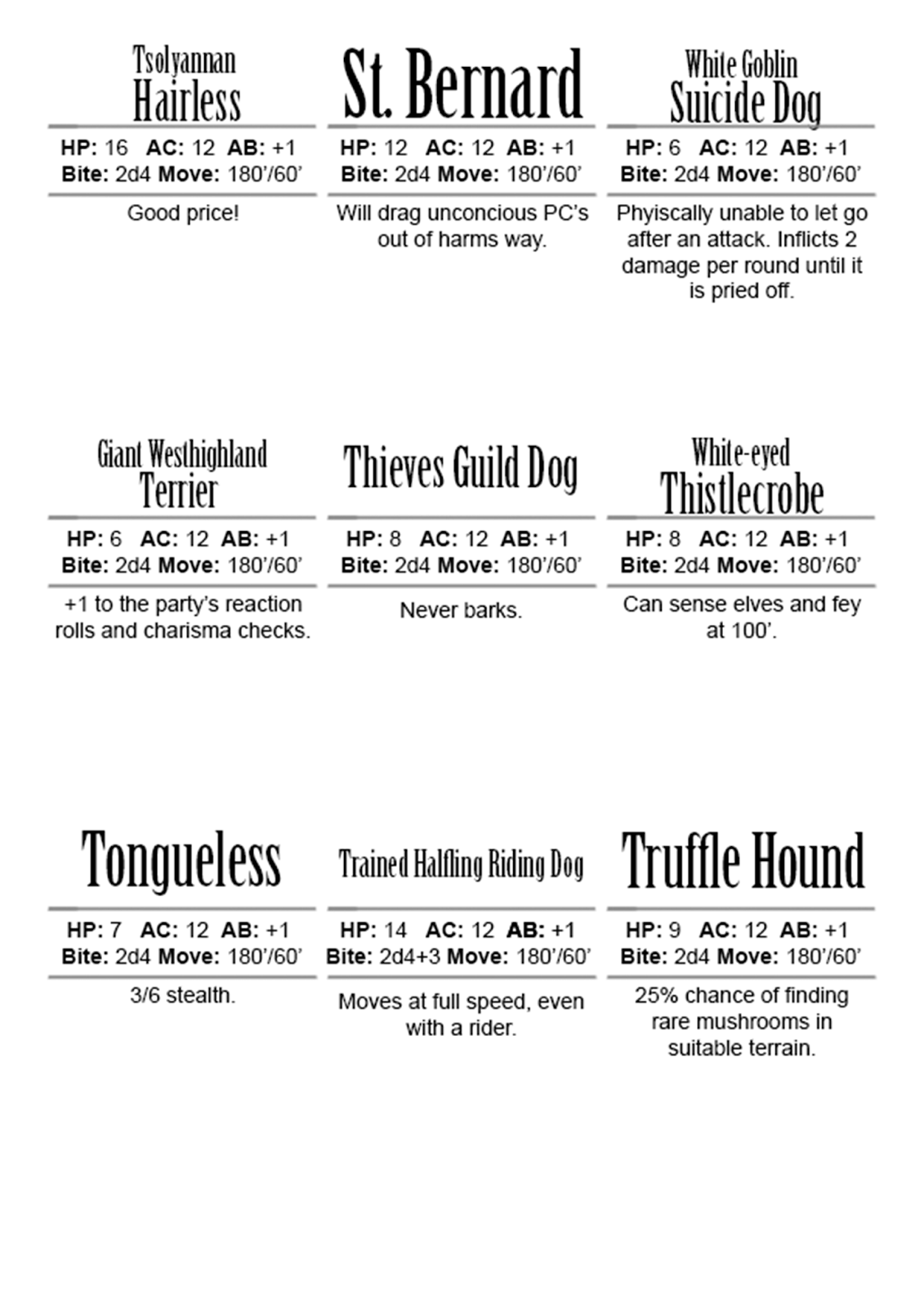
I also made cards out of the entries in Zak's Available Dog Table.


 I printed them out, cut them up, and put them in card sleeves like these. Put a handful of them on the table at the beginning of the session, haggle for the price of each on an individual basis. "This dog dragged my grandmother from the ruins of our burning village! I couldn't accept less than 10 gold."

It worked really well. The spell cards were perfect for functionality, cutting down on character creation time and making it obvious what spells were available and memorized. The Dog cards were lovely as a ridiculous frippery. It's great how much dog descriptions can add to the world.

(eg.: "Why is the Carcassian Hoghunter trained to disarm enemies with a bite to the hand?"

"Clearly you've never seen a Carcassian hog.")

What I love most is that you can have an enormous world of possibilities, but your players only need to choose from a tiny amount of them at one time. So first, the world is bigger and stranger and more mysterious: you know this shop doesn't sell every dog in the world, and that you may never even see every dog in the world. Every shop is surprising and new. Second, it reduces the amount of time people spend staring down at pieces of paper, deciding what to buy.*

(The original table and this random generator version did both these things, but I never had easy access to the internet to get to it, and I like how instantaneous it is to just give people a card. No writing down, no rubbing out when the dogs die in waves.)

The only problem I found is that dogs can't really replace Hirelings: you can't play as your dog after you die. I wonder how far I should take this. A deck of hirelings? A deck of weapons, instead of using the equipment list? I'm very tempted to splurge even further and have decks for Weapons, Magic, Dogs and Men.

Rules for Magic, and the Speaking Gun


Knock Knock is this little cartoon game that manages to evoke utter terror in me. It does it with a simple trick: All the rules are told to you in-character, by multiple flawed and contradictory sources.

So, your little avatar tells you how to play the game. You move from room to room, fixing broken lights. Then he warns to to turn off the lights as soon as you fix them. He has a dream where something outside can see the lights go on.

Soon, you start finding pages from your diary. They make a counter-claim: monsters spawn in dark rooms, so you should leave all the lights on. They also start giving you the rules for some other games. Your avatar can't remember writing any of this. 


You hear voices: a man and a girl. They tell you things that seem to help, but they also laugh when you stumble into one of the shaggy things roaming around your house.

The result of putting the rules in these three sources: I can play the game, and I roam around the house doing things that seem to be working, but everything is shrouded in this mystery that gives me constant, terrible paranoia. Is this actually the right thing to do? Am I missing some crucial rule? What effect is all this actually having? Instead of following orders, I'm piecing them together something mysterious: A detective, instead of a soldier *

  • Follow the rules of the game! Of course you must first understand the game being played with you.
Obviously this is how magic items should work. Scholars and soldiers and folk-tales all disagree on what it is, what it does, and who made it. Your players have to piece together which, if any, of these claims are true.
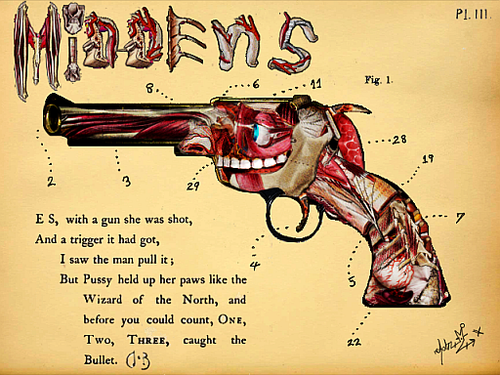
  1. Pistol: Someone has crudely engraved a mouth on the grip. It's a common superstition, said to increase your aim. It recalls the legendary "Speaking Gun", which told Janus everything about his enemies, making sure he could never lose.
  2. Theological analysisThe "Executioner that Spoke" was actually a metaphor for the terrible indiscretions of Pope Johan Riechart III. The original text describes a bloody tube that destroys the sinner's enemies, but eventually turns on him by "Speaking his name", and thus "Scattering him to every corner of the earth." This represents the Pope's trio of murder-men, who spoke his name in court and thus sentenced him to torture and death. 
  3. Local folktale: Jakob was an envious man, who prayed and received a miraculous pistol. Jakob turns the pistol on a picture of his brother: it speaks his brother's name, and Jakob inherits his brother's wealth. He points it at a portrait of the king: it speaks the king's name, and Jakob inherits the crown. Finally, he runs to the cathedral and points it at the fresco above - but this time, the gun speaks Jakob's name, and he is turned into a monster.
  4. Children's book (1sp):
  5. Journal of a Satanist (Worth 1,000g to the church, who will destroy it and/or anyone who's read it. Written in an ancient language)They cut out god's tongue. That's why he doesn't speak anymore. I saw it, on the lowest level: A vast hollow tube. There's no wind down there, but something moves through it. 
  6. Superstition: If you speak someone's true name backwards, they are unmade completely. They do not exist, they will not exist, they have never existed.
  7. Religious text: But Joseph descended from the mountain; and in his left hand was a great light. And it called Mahanaim, and Edom, and Careb; Nahbi; Kibzaim, Keziz, and Samuel; and all it called fell down around him.
  8. Mural in ruins of civilization (5,000g if it can somehow be retrieved for a gallery). Panel 1: An old warrior. Panel 2: He enters a tent, where a lump of flesh sits on an altar. Panel 3: He points the lump to his head (right handed). Panel 4: His body is stripped from him. Panel 5: His soul wreaks havoc on the enemy.
  9. Asylum patient records: ...strange wet noises coming from his hand. Heinrich claims the "Gun" suckles on his palm. He takes this as more evidence that the thing loves him. No matter how many times I throw the thing away, he somehow manages to get it back in his hands again.
  10. Asylum records:..has been completely mismanaged. Several patients have gone years without being assigned a psychiatrist. Heinrich still claims he had a "Dr. Reed", which the gun devoured. Unable to find anyone of that name in our records - possibly a childhood friend of his?
  11. Black box d10 x 50g: Inscribed with symbols of an ancient cult. Inside is a tiny lump of meat on a velvet cushion, clearly once part of something larger. They say that cult used to have a stronghold on a mountain to the east... 
  12. Statue: Man holding up his left palm, which has a hole straight through it. Often placed at entrances and windows, to guard against spirits. The hole is designed to make an eerie whistling when the wind blows through it.


*Ice-Pick lodge loves using this trick. In The Void, you learn from 10 sisters and 10 brothers, who all explain the rules from their own points of view. The first sister, for example, tells you how to progress in the game, then warns you not to do it under any circumstances. Don't go out into the game, don't try to win. If you stay here in the tutorial, time will never go forward, and nothing bad will ever happen. We can live here forever.

When you leave her island, something terrible happens to her.
Tyrant, one of the Brothers

Spirits to Summon


Summoning Errata


If you attempt to call on your Patron for aid and don't get a roll good enough for the request you wanted, a Demonic patron will be happy to add on points until you can get whatever assistance you need... for a price. A small favour, a small sacrifice, something that gives them a just a little more power over you. Any patron who doesn't want to cause you harm won't grant you this luxury.


Spirit List


Gain a level 1 summon slot whenever a cleric in your system of choice would gain a level 1 spell - the same for levels 2 through 5. You should let them choose instead of rolling for it.This list obviously doesn't represent every single type of spirit that exists. Feel free to let the summoner capture any of the ones you make up in the normal course of the campaign.

I'm walking a fine line here - the risk is that the summoner could summon spirits who are great at fighting, thieving and magic and make the rest of the party redundant. Summoned spirits will always be more unreliable than PC's, so hopefully that won't be a problem.

Still, none of this has been playtested, and I'm still unsure exactly when you should be rolling a command check - you definitely don't want to be rolling a command check and a to-hit roll every time you want your minions to attack. Post a message on how it went if you end up using this - I'll do the same when I get a chance to use it.

1st Level


1. Unseen servant: an invisible imp that can carry 20 pounds. It's taken an oath to do no harm - if it discovers that it has been tricked or forced into breaking that oath, it will immediately break it's bonds and go crazy.

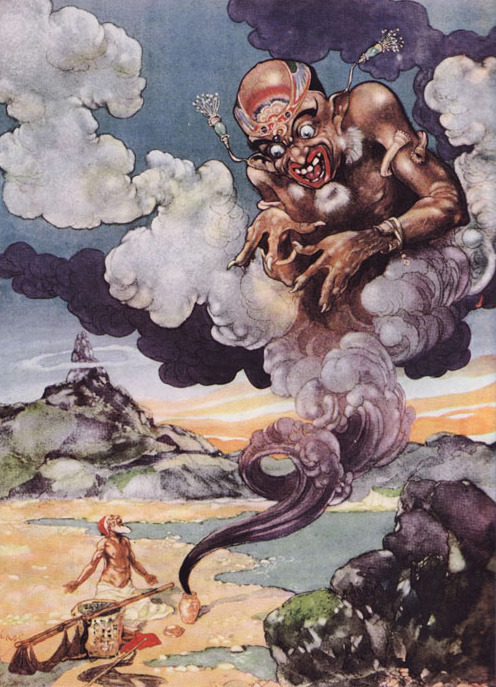
2. Baby Ifrit: just a little spark of living fire. No physical mass, but can set things on fire and do d6 damage if it flies into someone.

3. Qarin: Tiny devil that sits on your shoulder and whispers secrets. Can sense magic, evil, etc - but may lie to you.

4. Swarm of bats. Can surround enemies to make it hard for them to see and attack.

5. Zephir: A living gust of wind. Can push enemies back or whirl around a target, making it harder to hit them. (Say, -2.)

6. Guardian. This creature can only exist in half-open spaces: ajar doors, windows, mirrors, etc. If summoned there, it can prevent others from coming through. In the wild it will traditionally bar passage to all who cannot answer a riddle, or abduct children to the fae realms as they pass through a door.

7.  Familiar. Not a spirit to summon, but an animal you have chosen and bound to you, so that it's life is permanently tied to yours. DCC has good rules for these, but to paraphrase: It gets 14 AC and d4+2 hit points (which you also receive). It is intelligent and completely loyal You can see through its eyes and gain any natural abilities it has (like sneaking for a cat, or breathing underwater for a toad). It may have other, magical abilities.

2nd Level


1. The spoon-sized boys: 2d4 tiny homunculi with daggers. Hard workers.

2. Spectral hound. Can track infallibly. Its howl causes fear.

3. Dead King. Ranks have no merit in the Dead Realms, but he can get information from other dead, knows history, stuff like that.

4. Shade: Attaches to someone by pretending to be their shadow. Feeds off them and drags them down like a curse.


6. Ape Ghoul: Stats as normal ape. Devours corpses to gain their powers for a day.

7.  Blight lamb. A hapless spirit that can be bound with the poisons of others. You can take a condition - paralysis, blindness, poison, or a disease - and force it out of the afflicted party and into the blight lamb. Be warned that the Blight Lamb may eventually die from the diseases you inflict on it. You can not transfer magical conditions to the Blight Lamb. If it breaks free it'll violently force its diseases into its tormentors.

3rd Level


1. Succubus. While sleeping beside someone, she can invade their dreams to steal their thoughts or memories and bring them back to her master. Thoughts and memories from other people could also be placed there. Y'know, Inception.

2. Giant spider-lady. You can ride her around, but she won't be able to climb up walls while you're on her back.

3. Doppleganger: Attaches to a target, takes on their features, and repeats their movements exactly - attacking what they attack, succeeding when they succeed, etc.

4. A pact with the Cold Dead Old ones. You can now summon the souls of the dead back into their corpses.

5.  Rage Demon. Possesses a target, taking control of them completely and driving them mad with rage. They will attack all in sight with twice the attacks per round they normally get.

6.  
Uri and Baki: Tricksy Aelfmaidens, madly in lust with and conspiring to destroy you.  They can teleport  and travel long distances fast by moving in and out of the fae realms.


7.
Curse Lamb. An angel sent to learn humility by bearing the sins of others. Like a blight lamb, but it may be bound with magical conditions, including curses.

4th Level


1. A Pegasus.
2. The kraken.

3. You've tapped into the vast spy network of pixies, dryads and fae - all the tiny folk that watch humanity and laugh. You can call upon them to report on the things they've seen - they can spy on anything that isn't magically protected.

4.  The Great Glass Head of Gruloctica comes forth. His mouth temple can fit about 10 people. Within this sanctuary, the party gets a bonus to all spells, healing, pleas for divine aid and so forth. Unholy creatures must make a save to enter. The head can't do much more than open and close it's mouth, very slowly.


5. Brain-worm: can burrow into a brain and take control over it. At first this will be simple - you can dictate their actions for a single round - but eventually this control will become total.

6.
Sacrificial Lamb. You may bind it to take damage for one member of the party - it will take wounds instead of them. Beware, its HP is finite.

7.
Plague! Just like the plagues of egypt; you can summon a swarm of locusts, rats, or other wild animals. These animals fill an area and attack all who enter it. They are all diseased.

5th Level


1. A dragon.


2. Beloch: One of the great demons, with influence over some of the highest rulers of the land. Can manipulate the high courts of man to bring you power and prosperity.

3.
Actorias the Gatekeeper, who holds all the pathways of the infinite planes; can open the way to the various realms of Death, Fae, Heaven and Hell and guide you on your journeys there.

4.
You can make the sleeping giants that form the mountains and bedrock of the world stir in their slumber - causing earthquakes, etc. On a natural 20, you wake them. They are likely to kill you, and everything.

6.  The legendary sword, Eterne. When you draw it, you may summon a legion of a thousand ghostly soldiers - the shades of all those who drew her before you. These are only half-real, and can't attack properly as an army unless rendered fully physical by special circumstances.

7. 
The Pledge of Predation. Spill your blood while chanting to open a chasm and summon Rondoclavusius. She will destroy all she sees - but her main goal is to find and devour you. She can be reduced to 0HP and thus immobilized, but will not die unless slain by your hand. You must then eat her completely to continue the pact.

Summoner


The Cleric class assumes that your setting has a very specific type of god. A noble and benevolent deity that loves healing and nature, and constantly fights against corruption and evil. An ever-present, all-knowing and all-loving god. A Christian god.

I've never played a game with this kind of god. I've had savage, thoughtless gods, whimsical trickster gods, cold and absent gods, pagan pantheons holding gods of every color - never a Most High God. Growing up with Christianity everywhere, my group finds Him pretty boring. I haven't played around much, but it seems like a lot of the blog-o-sphere must feel the same way. The gods I've seen take more inspiration from Moorcock, Vance and Lovecraft than from the bible.

People still play Clerics, of course, so I shoe-horn the Catholic stuff into my weirdo gods. My goofy crocodile trickster god gives his clerics the power to heal, help others, and destroy the wicked, as does my dual-aspect insect god. So does Zak smith's Grim, Gaunt God of Iron, Rust and Rain. So does every one of these, I assume. Maybe the evil gods get to be Catholic Satan instead.

DCC has a slightly different problem. Whenever a DCC cleric fails a spell, they incur disfavor. This disfavor builds up over time, making them more and more likely to suffer the wrath of their god - until they take a rest for the day, whereupon it resets to 0. So, along with the catholic baggage, all gods are now crazed, wrathful avengers with the memory of goldfish. They get pissed off whenever you use the spells they gave you, only to instantly forget that on the next day.


There's nothing wrong with playing a game with catholic gods - even blind, angry ones. It's just that making every god with a cleric the same is a terrible waste. So here's my alternative: A Summoner. A more pagan kind of Cleric that's in communion with all the various demons, Fairies, Loa and Jinn that span this wild world. You can use them instead of a Cleric or side-by-side.

Commanding the Spirits


Every tree, forest, ocean and mountain has it's own spirits. As a summoner, you can command them. Use the same stats as a Cleric, but gain a Summon Slot every level instead of a spell slot. This lets you make a pact with a new spirit, which you can then summon at will. (You can play out tracking down and binding of this new spirit, or just automatically gain it - DM's choice.) You roll a Command Check to order these spirits  around.*

Command check: Roll d20 + your WIS modifier + half your Summoner Level. 


The check is 10, +2 per level of the spirit. So you need 12 or better to command level 1 sprites, 14 for level 2, etc.


If you succeed, you can give them a single command - usually a normal action, like "Go here and do this". Once it's completed it's task the demon may disappear or sit around to watch the show, but you'll need to re-roll the Command Check every time you want to give them an order.


Whenever you fail the Command Check, you gain one Disloyalty. This adds 1 to your Critical Fail chance for Command Checks, representing the weakening of your bindings. Disloyalty builds up over time, resetting when you sleep. If you ever critically fail a command check, one of your spirits will burst free of your bonds and start causing havoc.

While free, a spirit adds their HP to the Command Check needed to bind them. You'll need to wear them down, then succeed at a Command Check to bind them again.

Healing

Drink, Drink!

You can sacrifice your servants to sustain you and your companions. Roll a Command check and order your minion to let the afflicted party drink of their blood. A level 1 sprite heals as "Cure Light Wounds", level 2 blood acts as "Cure Serious Wounds", and level three is "Cure Critical Wounds". Once you do this, you won't be able to summon them for the rest of the day.

When you get up to a high enough level, you gain enough control over your minions to bind them into objects, or even dead bodies. To do this, you need to be 5 times the level of the spirit - level 5 Summoners can bind level 1 spirits, level 10 summoners can bind level 2 spirits, etc. (For DCC, it's 2X the level of the spirit.) 


Patron

Arioch, Arioch! Blood and Souls for my lord Arioch!

You have one powerful Patron - your god, or a powerful demon. This spirit gave you your power, in exchange for your True Name. Your soul will go to them when you die. It's up to you whether this thought fills your days with joy or wakes you up in a cold sweat every night.


You can call on them for Divine/Infernal Intervention. Roll a Command Check. A 10 gets you the simplest request possible, 12 is useful, 18 is incredible, up to an apocalyptic 30. The power of them entering this world makes the spirits restless, and weakens all bonds; add +10 to Disloyalty when you summon them.

Spirits for the rest of the party


Everyone can ask the spirits for aid, even if they can't actually summon them. You can find, make or buy charms dedicated to Gods, Demons and Sprites, and roll a Command check once per day to ask one of them for help. For non-summoners, that's d20 + your Wisdom modifier. Like Patrons, you can make a request equal to the number you rolled - 10 for the most useless thing imaginable. What they can do depends on the spirit - a sea god could protect you from drowning, but be useless against fire.

NPC's will typically ask for good crops, help in childbirth, or protection from barnacles on the hulls of their ships. PC's will likely want something more obvious, but the effect will always be passive and invisible - a bonus to dice rolls, better AC against unholy creatures, protection from disease, that sort of thing.  


You can get a bonus to your command check by making offerings to the spirit. Tropical Loas love candy and rum, fairies love music and houses of cards, Christian gods want dedicated worship and acts of goodwill. You can use this to become a kind of paladin - dedicate yourself to a god, make their sacrifices and wear their charms to get their aid with your fighting, thiefing, or magic-using.

The old gods have no power in the South... You may find that your charm's power wanes as you enter the territory of a foreign god. Suffer a -1, -2, etc to command checks for amulets as you get further in to those hostile lands.

*Next up: A full list of spirits you can summon. 


Appendix N: Dying Earth, Elric, the Wizard-Knight books, Clandestinauts, Pokemon.


Something weird

In classical D&D, almost everything is uncertain. Your best attack will miss, your best defense will fail, and everything always has a five percent chance of turning into slapstick at any moment. In this crazy world, there's only one thing that amounts to a hill of beans:

Magic.

— Angus McBride

Magic is the one pillar of sanity and reason in a world of 50% fail chances. It's the only thing that will reliably work exactly the way you want, at exactly the right time, every time. The best thief in the world can fall off the roof, the best fighter can fling a sword off into his pal's head, but even the lowliest wizard is in complete control of every aspect of his unearthly powers.

Isn't that fucking weird?

I think DCC is a good step on the road to the mythical Perfect Magic System on the hill, and I'm going to try to keep climbing a bit in the posts to come.

DCC Magic for the rest of us.


I love the chaos of magic in Dungeon Crawl Classics, but if I look up another spell table I'll go insane. Here's a simple version for you folks at home.

To cast spells, a wizard must roll a spell check. Roll a d20, add your Intelligence modifier and your level as a Wizard, and try to beat the spells difficulty. That's 12 or better for a level 1 spell, 14 or better for a level 2 spell, 16 or better for level 3, and so on.

If you succeed, you cast the spell and keep it. If you fail, you lose the spell for the day. On a natural 20, you get some incredible super version of the spell. On a natural 1, the spell backfires hilariously and you become hideously corrupted. The DM should just make these critical spell effects and mutations up on the spot, taking into account the context. DCC has plenty of examples, and you can use The Benefactors for inspiration.

Clerics are slightly different. First, they add their Wisdom/Personality modifier to spell checks instead of Intelligence. Second, when they fail, they incur Disfavor from their god instead of losing the spell. Disfavour adds 1 to their critical fail chance for spells. When they inevitably end up critically failing a spell, their god curses them. Make up some terrible fate based on their god.

A cleric spends all day pissing off her god, and all night trying to patch things back up again. Clerics can get rid of disfavor by pleasing their god with sacrifices and the like, and all Disfavor disappears if you spend your normal 9+ hour rest in deep meditation and prayer.

— Ken Kelly
The Elemental

Magic-users can improvise special effects for a spell, in the same way that a fighter can improvise exciting ways to stab someone. Say, set the ground on fire instead of sending out a Fireball, using Turn Unholy to destroy demonic artifacts or Sanctuary to stop monsters from entering a room. Anything that fits in with the general feel of the spell is fine. Just raise the spells difficulty by 2, 4, 6 or more, based on how hard the thing they're trying to do is. EDIT: or you could use this called shot mechanic. Raise their critical fail chance and lower their critical hit chance. The crazier the thing they're trying to do with it, the more likely it is to misfire.

This is my favorite idea on this page. DCC has a lot of spells like "Force Manipulation", which could give you an invisible weapon, platform, blockade or manservant, depending on your roll. The variability is great, but having it depend on a roll sucks. This rule makes normal spells as free-form and weird as they are in DCC and gives power to player creativity instead of forcing them to look shit up in a book.(!!!)


All spellcasters have friends in high places. Wizards can call on the despicable beasts they've made obscene pacts with, and Clerics can call on their Gods. If they want to ask their pals for aid, have them roll a spell check as usual. They can ask for a favour as good as the roll allows; beat 5, 10, 15 or 20, where 5 is a minor boon and 20 is apocalyptic. Wizards will of course have to satisfy some dark price later on (again, see The Benefactors). For Clerics, asking their god for Divine Intervention incurs +10 to Disfavor.

(This means that clerics will generally ask their god for help at least once a day, while Wizards will avoid getting in debt to their Patrons unless they can possibly help it, and then wish they hadn't for the rest of the game.)

You can use this system to DCC-ify spells from other versions of D&D. Vancian spellcasters should get all their spells, instead of memorizing a set number of them per day. This may seem like a lot, but that high failure rate means they'll lose plenty of them without casting them. Clerics and wizards should both start with about 4 spells and get one more per level.

On adding your level to spell checks: in DCC, level 10 is the max. Adding 11-20 to a spell check makes the whole thing a little redundant, so you might want to consider giving out that +1 to spell checks every second level if your system goes up to 20.