Showing posts with label Encumbrance. Show all posts

THIS HAUNTED LAND

Brian Froud.

"What a happiness this must have been seventy or eighty years ago and upwards, to those chosen few who had the good luck to be born on the eve of this festival of all festivals; when the whole earth was so overrun with ghosts, boggles, bloody-bones, spirits, demons, ignis fatui, brownies, bugbears, black dogs, specters, shellycoats, scarecrows, witches, wizards, barguests, Robin-Goodfellows, hags, night-bats, scrags, breaknecks, fantasms, hobgoblins, hobhoulards, boggy-boes, dobbies, hob-thrusts, fetches, kelpies, warlocks, mock-beggars, mum-pokers, Jemmy-burties, urchins, satyrs, pans, fauns, sirens, tritons, centaurs, calcars, nymphs, imps, incubuses, spoorns, men-in-the-oak, hell-wains, fire-drakes, kit-a-can-sticks, Tom-tumblers, melch-dicks, larrs, kitty-witches, hobby-lanthorns, Dick-a-Tuesdays, Elf-fires, Gyl-burnt-tales, knockers, elves, rawheads, Meg-with-the-wads, old-shocks, ouphs, pad-foots, pixies, pictrees, giants, dwarfs, Tom-pokers, tutgots, snapdragons, sprets, spunks, conjurers, thurses, spurns, tantarrabobs, swaithes, tints, tod-lowries, Jack-in-the-Wads, mormos, changelings, redcaps, yeth-hounds, colt-pixies, Tom-thumbs, black-bugs, boggarts, scar-bugs, shag-foals, hodge-pochers, hob-thrushes, bugs, bull-beggars, bygorns, bolls, caddies, bomen, brags, wraiths, waffs, flay-boggarts, fiends, gallytrots, imps, gytrashes, patches, hob-and-lanthorns, gringes, boguests, bonelesses, Peg-powlers, pucks, fays, kidnappers, gallybeggars, hudskins, nickers, madcaps, trolls, robinets, friars' lanthorns, silkies, cauld-lads, death-hearses, goblins, hob-headlesses, bugaboos, kows, or cowes, nickies, nacks [necks], waiths, miffies, buckies, ghouls, sylphs, guests, swarths, freiths, freits, gy-carlins [Gyre-carling], pigmies, chittifaces, nixies, Jinny-burnt-tails, dudmen, hell-hounds, dopple-gangers, boggleboes, bogies, redmen, portunes, grants, hobbits, hobgoblins, brown-men, cowies, dunnies, wirrikows, alholdes, mannikins, follets, korreds, lubberkins, cluricauns, kobolds, leprechauns, kors, mares, korreds, puckles korigans, sylvans, succubuses, blackmen, shadows, banshees, lian-hanshees, clabbernappers, Gabriel-hounds, mawkins, doubles, corpse lights or candles, scrats, mahounds, trows, gnomes, sprites, fates, fiends, sibyls, nicknevins, whitewomen, fairies, thrummy-caps, cutties, and nisses, and apparitions of every shape, make, form, fashion, kind and description, that there was not a village in England that had not its own peculiar ghost.

Nay, every lone tenement, castle, or mansion-house, which could boast of any antiquity had its bogle, its specter, or its knocker. The churches, churchyards, and crossroads were all haunted. Every green lane had its boulder-stone on which an apparition kept watch at night. Every common had its circle of fairies belonging to it. And there was scarcely a shepherd to be met with who had not seen a spirit!"


Source: The Denham Tracts, edited by James Hardy, (London: Folklore Society, 1895), vol. 2, pp. 76-80.


I'm toying with the idea of making an RPG where you play as tiny imps, goblins, bugaboos, pixies, and other chaos-spirits who venture out into the world of men to steal and cause mischief.


The core mechanics would be heavily inspired by the chunky, toy-ified inventory system in Mausritter. You should click that link to read the pay-what-you-want PDF rules if you haven't, the system is fantastic.
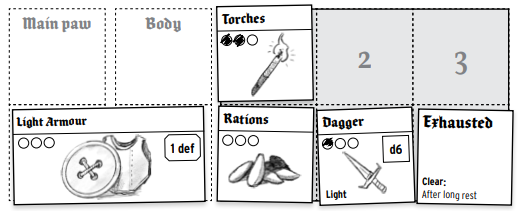


Each item is represented by a physical chunk of cardboard that takes up physical space in your inventory. Like in Knave, your inventory is your character. All the character customisation and everything that makes you a wizard or a thief or a fighter comes from your inventory.

In this game, on top of the normal physical items from Mausritter, your inventory would also hold intangible objects. Sprites can bargain for memories, thoughts and dreams. They can steal away a person's courage or a year of their life. They hoard truth, beauty, and human souls. All of these things become objects in your inventory.

Here's how I'm thinking of doing it:


SPELLS ARE CAPTURED SOULS


You can collect souls by making a deal with the living. Sometimes, you can also find them trapped in the corpses of the dead. Spirits typically collect souls in a bottle or some kind of talisman. A normal soul takes up 1 slot in your inventory and has 3 uses.

Souls are used to cast spells. They work just like spells in Mausritter, which used ideas from Glog. You can mark uses to get Magic Dice, which you use to cast it. The more dice you use, the greater the effect.

To regain uses, you have to do something the soul wants. For example, the first soul here wants you to break promises, leave friends for dead, or betray your allies. If you do anything that fits that description, you can recharge 1 use. A particularly big example of doing what the soul wants could recharge more, at the DM's discretion. You can only recharge each soul once per day.


Soul of a:

Effect

Personality

Wants you to

1

Hanged Thief

Make target invisible for [DICE] turns. Any movement reduces duration by 1 turn.

Paranoid, secretive, fickle & irresponsible.

Break promises, leave friends for dead, betray allies

2

Forgotten Tyrant

Shoot a fireball up to 24'. Deal [SUM] + [DICE] damage to all creatures within 6'.

Angry, brutish & insecure.

Prove your strength, dominate others, gain power.

3

Leper Saint

Heal [SUM] STR damage and remove the

Injured Condition from the target.

Self-sacrificing, peaceful, timid & meek.

Sacrifice yourself for others, deny your own needs, submit.

4

Daredevil Acrobat

Target can walk along walls and ceilings for [SUM] turns.

Cheerful, devil-may-care & egotistical.

Take unnecessary risks, gamble your life, get attention.

5

Buried Giant

Grow a creature to [DICE] + 1 times its original size for [SUM] turns.

Nostalgic, slow, thoughtful & depressed

Preserve history, prevent change, bury ancient artefacts.

6

Doomed Lamplighter

Create a 20ft cloud of impenetrable darkness for [SUM] turns.

Despairing, gloomy, hyper-critical & fatalistic. 

Fail dramatically, undertake doomed quests, suffer a terrible fate.

7

Disgraced Detective

Open a door or container, as if a Save were made with a STR score of 11 + [SUM].

Stubborn, desperate, lawful & uncompromising.  

Discover the truth, uphold the status quo, punish chaos.

8

Slick Con-man

Cover [SUM]+2' area in slippery, flammable grease. Creatures in the area must make a DEX save or fall prone.

Fast-talking, always has an angle, everyone's a sucker.

Shirk obligations, escape justice, sell snake-oil, cheat and swindle.

9

Corrupt Politician

The target regards you as a good friend for [SUM] turns.

Laid-back, charming, boastful and proud.

Make dangerous deals, get in over your head, hatch cunning schemes.

10

War-Dog Trainer

Create an illusory dog that can carry [SUM] inventory slots for [DICE] x 6 turns.

Blunt, gruff, brutally honest, secretly caring.

Care for strange and dangerous creatures, take in strays, save captives.

It's inspired by the skills in Disco Elysium. In Disco, all of your skills have their own personalities, and they're constantly butting in with their own ideas about what you should be doing. They feel vibrant and noisy in a way I really want to replicate.

I think this recharge mechanic is an elegant way to make it feel like the souls are whispering to you. In Disco Elysium, the game is constantly making passive checks in the background to see if your skills chime in to interrupt you. But a GM in a tabletop game doesn't have the brain-space to do that.

Tying it to the recharge mechanic puts it in the players hands. They want to recharge their stuff, so they'll always be looking out for opportunities to do something the soul wants. That mimicks the feeling of the soul whispering in your ear and pushing you to commit vile deeds.


SKILLS ARE STOLEN MEMORIES.


Memory of being lost in the woods. 

"Don't worry," your father said. "I'll be back soon."


Memories can be bargained for, or stolen out of the heads of sleeping humans. A normal memory takes up 1 slot in your inventory and has 3 uses.

Whenever you make a check that's relevant to the memory, you can mark 1 use to give you advantage to that check. You can also use a memory to give an ally advantage to a check in the same way.

For example, this memory of being lost in the woods could be used to grant advantage to checks related to survival, nature, or tracking.

When you first get the memory, you and the GM would collaborate to decide what exactly the memory shows, and what kind of checks it should apply to. It would be an open discussion. The memories would all be deliberately a bit odd to encourage outside-the-box thinking and creative problem solving. Nothing like "Memory of swinging a sword." Instead, things like:

Memory of discovering an awful truth. 

A hidden letter. A family secret. You never should have opened that door.


In this way the inventory system also acts as a simple skill system. Whether your character is a skilled tracker, pickpocket, social manipulator, etc - you can customise all these things based on what memories you have in your inventory.

I'm not sure memories should recharge during downtime, or if they should just be gone for good once they're used up. Perhaps you would need to re-enact the memory in some way to recharge it.

HEALTH AND RIOTING


You start out with d6 HP at level 1. Once your HP is depleted, your items start taking damage.

Each item can soak 1 damage per slot it takes up. So, a 2 slot item can take 2 damage. You always choose which items soak the hit. If you take damage and you have no items left to soak with, you die.

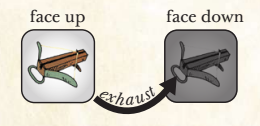
I'm imagining you flip the items over to show that they're damaged. Inspired by the board game Root.


Your items are stored in up to 12 inventory slots labelled 1-12. Whenever you damage your items, you roll a d12. If it hits the number of a slot that holds a damaged item, that item riots. It goes out of your control and starts acting against you.

There would be a whole table for this in the final rules. Souls could fire off randomly, or take possession of you and begin forcing you to do things. You could become trapped in a memory and unable to tell what's real. Weapons could misfire, items could fall out of your pack and roll away from you. Etc etc.

Your inventory should feel loud, vibrant, chaotic. Always whispering to you as you play.

HP would be very easy to heal - A short rest of a few minutes would heal d6+1 HP. Inventory damage would be your "Meat damage", more serious and hard to recover. Perhaps a long rest would heal d6 slots worth of items, or possibly you'd need to head back to a friendly goblin town to repair.


AND MORE


I'm imagining a huge variety of items which would act a bit like Feats, GLOG templates, or special abilities in other games. Possible options include:
  • Stolen Beauty: Mark 1 use to gain Advantage on a reaction roll (roll 3d6 and take the highest 2 dice).
  • Stolen Voice: You have stolen someone's voice. Mark 1 use to mimic their voice perfectly for an hour. You can pass yourself off as that person with a successful Charisma check.
  • Bottled Luck: Mark 1 use to re-roll a natural 1 from you or an ally.
  • Dream of Falling: Mark 1 use to cancel all damage from a fall.
I'm thinking abilities like this would be fairly rare, something you only get after a major milestone or quest.

Potentially you could even increase your basic stats with items like this, like "Stolen Strength: +1 STR". If I went down this route, I could replace levelling up completely with the inventory system.

Gaining a level could simply give you +1 or +2 inventory slots (which would also, elegantly, give you more health and survivability). All the other aspects of levelling up like increasing your stats, getting more skills, gaining special abilities, etc - it would all be done with items. I'm very tempted by this idea.

The neat thing about this is that it puts the character customisation choices in the game itself, rather than in choices made outside the game. If you want to be strong, you have to hunt down a strong person and steal their strength. It's not a matter of choosing a specific feat in-between sessions, or making a choice in character creation. It's a choice that you made and carried out in the game world.

MONEY


Potentially the Spirit currency could be years. Each coin represents 1 year of your life. If you lose your last coin, you are fated to die within the next 2d10 days.

But, I equally like the idea of focusing on a barter system with no currency at all, to move away from standard D&D money systems. Needs more thought.

APPENDIX N


This system was partially inspired by the GLOG hack BONES.As I was writing it, I was also surprised to see this post on Mental Encumbrance pop up. I guess great minds think alike.

Both BONES and the Mental Encumbrance idea have separate inventories for your physical items and your mental items (I.E. Spells, skills, and intangible notions). I experimented with this idea a bit but in practice, I found it wasn't giving me the tough choices I wanted. I found I could carry heavy weapons and armour in my physical inventory, and also carry a ton of spells in my mental inventory. I didn't have to choose between them as much.

I like the idea of having all these things take up the same inventory. It's simpler, and forces you to make more interesting choices.

TO BE CONTINUED!?


I have a lot more ideas about the overall structure. Basically, the game would be focused around factions. Each faction would come with a list of unique items which you could either steal from them, or gain as quest rewards. You would work with or against these factions to earn unique items and improve your character. But I'll have to elaborate further in another post.

I'm not sure how far I'll go in developing this idea, but I'm interested to hear what people think. Let me know if you have any feedback or ideas in the comments.


Greed & Speed Treasure Tracker


Write every piece of treasure the PC's find on this sheet of paper. As the party fills up the slots through 1, 2, 3 and 4, they grow slower as a group.


This symbol shows how often the party has to roll a wandering monster check. The top is every five rooms (or 120 feet if you feel like counting squares). As they lug around more treasure they walk through rooms slower, which means they'll need to roll more often. This group speed has no effect on how far each individual character can move.*

For those unfamiliar with wandering monsters: There's a 1/6 chance of meeting a group of random monsters every ten minutes. The distance under this symbol is an abstract representation of how far the party can move in that time. You should also roll on top of that whenever the party does something that would take ten minutes (Like searching a room or fighting some dudes), or make a lot of noise (Like breaking open a door). 


This is the party's Flee check. If they need to escape a bad situation, the party and the monsters both roll a d20. The heroes adds the number next to this symbol. The monsters may add +2 if they're fast, or -2 if they're slow. Whoever rolls highest has outrun the other group. If the monsters win, they get a free attack. If they party wins, they escape - but the monsters will still be somewhere behind them.

Why Group encumbrance? Why only for treasure?


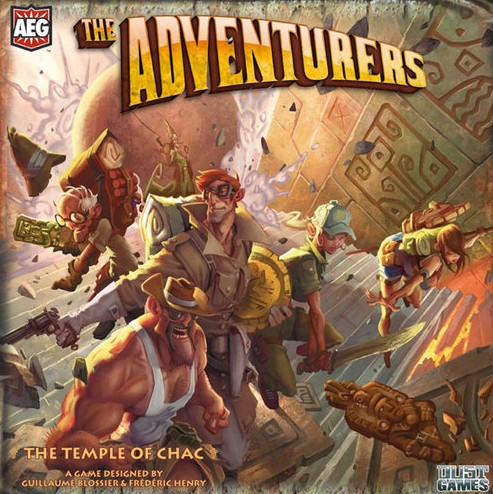
Ok: "The Adventurers" places you as a group of tomb-robbers fleeing from a rolling boulder. The more treasure you seize, the slower you can outrun the boulder. At the end, the character who escaped with the most treasure wins.

Encumbrance is meant to be the same kind of risk/reward mechanic. The more treasure you pick up, the slower you go, the more wandering monsters you roll. So in a very direct way, picking up more treasure makes you more likely to be killed. Escape with enough treasure, and you can level up.

I can reach it!
I love that idea, but two simulationist mechanics have obscured it with book keeping.

1. Encumbrance is tracked individually, but the party moves as a group. Unless you split up, the difference is meaningless.
2. Encumbrance is tracked for everything, not just treasure. You're not being penalized for being greedy, you're being penalized for being cautious (by bringing a lot of stuff into the dungeon).

Matt Rundle's Anti-hammerspace Item Tracker is still my only love, and the only way I'd think of tracking individual items. Greed and Speed is designed for a different purpose: condensing the risk/reward of old-school treasure hunting down to it's purest, abstract form. 

(As a side benefit, it should unify the players a little. It's a specific sheet in the middle of the table, bulging with the treasure they've earned together - there's some pride in that.)

This is part of my ongoing attempt to understand old-school dungeon crawling, and make all these old weird rules I always forget actually work for my players. I'm running Barrowmaze, and the Crawl still isn't perfect yet: player mapping and light sources are still strange round pegs I'm trying to slot into the square holes in my table. I'll keep turning it over, and let you know what I'm trying out.

*If you want, you could even leave one character behind with the treasure and have everybody else move as if they're unencumbered. 

This is a terrible idea.

Skeleton silhouette from Roles, rules and rolls.


Morgan Brackish Meadows' Anti-Hammerspace Item Tracker


In Jack Vance's pulp fantasy Cugel's Saga, keeping track of your items is a big deal. Cugel the clever loses his items almost as soon as he gets them - stolen, smashed, misplaced, or most often, abandoned as Cugel flees from an angry mob. Cugel doesn't track encumbrance, but placement; because his items occupy a definite space in the world, everything in the world can effect them.

By contrast, items in DnD occupy a vague hammerspace somewhere around your character, where they can be teleported into your hands at any time. Traditional encumbrance systems work to weigh you down, but not to define where your items actually are. It's almost impossible for a DM to fuck with items in this hammer-space - you have to ask where the player's keeping them, they have to make something up, and you have to shrug and say "Well, they're gone now." It feels like cheating.

No more! I present Morgan Brackish Meadows' Anti-Hammerspace Item Tracker (I helped).  This item-tracking sheet is designed to ground your items in the world without wasting a second of time at the table. Each character can carry 6 containers, and each container has 3 slots. The player defines what each one is - a sack, a utility belt, a backpack, whatever. Wearing Leather armour or better takes 1 container, Chain or better takes 2, Scale or better takes 3. The player just writes down or draws each item in a slot as they get it.

Examples:

Stoner the Warrior

Cray the Thief


Some guidelines: A dagger is 1 slot, a short-sword is 2 slots, a longsword is 3 slots. 1 weeks food for one person is one slot. In my campaign you can get a +1 AC shield that takes up 1 slot, or a +2 AC shield that takes up 2 slots. Misc is for anything you're wearing, your animals, tiny objects, and anything else that  wouldn't take up a slot. If you really want to add encumbrance, give them -5 feet of speed a turn per container. For mounts, use this same sheet and cross off containers based on the armour of their rider. 

This is a harsh system that will see fully-clad warriors carry little more than food, weapons and gold. Personally, I love that - Conan never had much more than a loincloth and a sword. You can still own as many items as you like - it's just that you'll have to write them under "Left it at home", rather than hulking all your worldly possessions around on your back as you fight.

I have never seen anything but a game show the protagonists worried about their items weighing them down. Worrying about where your items are, though, is a staple of Pulp. Your arrows fall out, your money-pouch is stolen, your food gets wet, a dinosaur eats your back-pack and your bedroll is set on fire. That's a pulp encumbrance system. A few items that matter, constantly under threat. 

I've been trying to capture that feel for a while now. One of my PC's was suspended by vine-tentacles over a carnivorous tree, and decided to throw lighted lamp-oil down into it's maw. Instead of teleporting it into his hand, I had him fumble with his backpack, holding flint and tinder in one hand and oil in the other, precious food-packs falling out into the maw as he tried to light the oil.

Encumbrance systems have always tried to tie your items into the world. They fail, not just because no-one can be bothered to do the math, but because they track weight instead of where the items areThis system solves that problem, and it feels like the only thing I could ever use. I'm going to try it in my next session, so I'll tell you how it goes.