Showing posts with label Mausritter. Show all posts

Dread Encounters

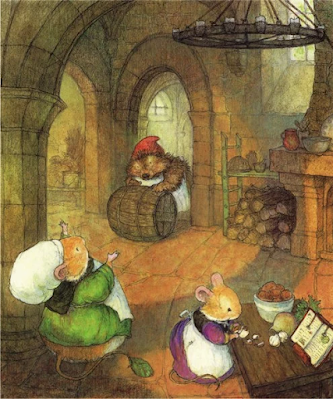
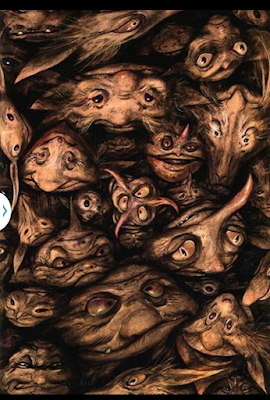
All illustrations by Russ Nicholson, Rest In Peace.

I just read this interesting post from Goblin Punch about changing the random encounter roll. 

The core design goals are:

1. To provide time pressure.

2. To create suspense. 

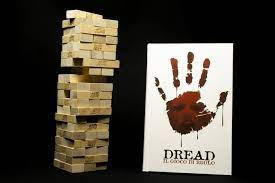
The Underclock achieves these goals but I have an alternate proposal: Let's take a page from Dread


Dread Encounters


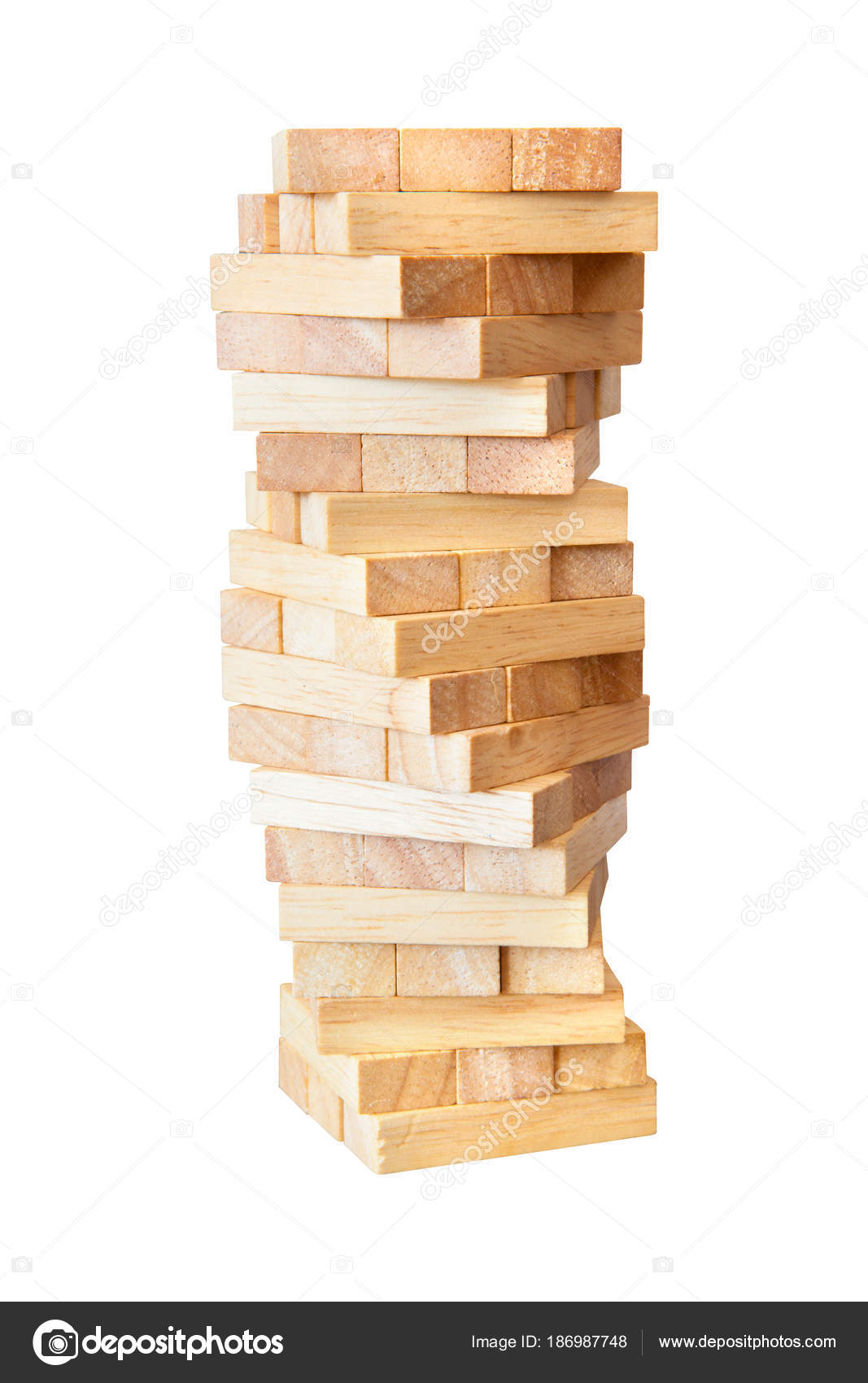
Whenever the party takes a meaningful action in the dungeon, they must pull 1 block from a Jenga tower.

A meaningful action is:
  • Entering a new room (exploring it and seeing what's there at a basic level)
  • Completing a full search of a room with the entire party (finding all secrets, traps and treasure)
  • Completing 1 normal combat
  • Doing something that makes a lot of noise (eg kicking down a door)
  • Completing a short rest
  • Moving through 3 rooms that have already been explored
  • Anything that takes around ten minutes
Whenever the tower wobbles, tilts, or almost falls over, give the players an Omen. They hear the beast in the distance. They see it's footprints. They smell the bitter iron tang of it in the air. Foreshadow the incoming danger to push up the suspense. 

When the tower collapses, the beast descends. The party has a Dread Encounter.


Beauty and Terror


A dread encounter should be monstrous. A major twist that's much, much more terrible and damaging than a normal random encounter. Some examples could be:
  • The evil forces accomplish a critical part of their plans. The lovecraftian entity is summoned. The hostages are killed. The ancient relic is lost forever. The rival party got to the treasure first and stole it.
    • This is a good default option. Think about what your factions want and have them achieve a major part of it when the tower falls.
  • A terrifying monster ambushes the party.
  • The dungeon undergoes a horrific metamorphosis. The environment changes and shifts in a fundamental and awful way. The earth shakes, rocks fall and damage you, your path to the exit is blocked off, mouths form in the rock. The Underworld is hungry. 
    • A great example of when to use this would be the Tower of Soot from The Estate. The players are climbing up a chimney. When the tower falls, the fireplace is lit and the whole dungeon catches fire.
  • Morale fails. Your hirelings riot or turn on you and attack. Try using this table for hireling freakouts if you need inspiration.
  • Your body fails. The corrupting magic energies of this place distort your mind and body. A carnivorous hunger falls upon you and you need to eat someone now. One of you is possessed by an ancient spirit.
Remember that on average this will happen after 30 pulls, so this should be a major twist and change in the situation, not just a normal random encounter. In Dread, it just kills a player instantly, so don't pull your punches! Just make sure you give the players lots of foreshadowing so that it feels fair.

Resting


Taking a short rest in the dungeon means 1 block pull (ten minutes). A long rest takes 6 block pulls (1 per hour). Either way, you need to mark off a ration to rest.

If you are in a completely safe location, you can rest without making any block pulls. For example, you're in a secret room or something totally locked off from the rest of the dungeon. 


Leaving the dungeon


When you leave the dungeon and head back to town, the GM decides.

A: If this is a perilous and urgent situation then the players must pull 2 blocks to leave the dungeon. The Jenga tower then stays as it is for the next delve. 

This represents the forces of the dungeon marshalling their strength while the players stay away. Use this option if the players have left the dungeon without accomplishing any real goals - for example, they've just peeked in the dungeon and scouted around a bit.

B: If the players have bought some time, they can use their hands to shift and stabilise the tower when they're about to leave the dungeon. They can put up to 2 blocks from the top back in the tower if they choose.

This is the option to choose if they have accomplished a minor goal like finding some treasure or delaying the evil plot. If the tower falls while they're doing this, they still get the dread encounter.

C: If time is on the player's side then the players can completely rebuild the tower, resetting it back to its starting position.

This is the option to use once the players have accomplished a major goal and escaped the dungeon. Defeating a boss, rescuing a key NPC or piece of treasure, etc.

Resource Attrition


If you want resource attrition, take a black marker and mark half the jenga blocks. 

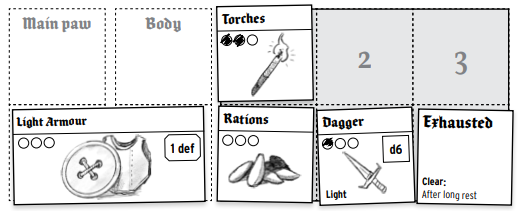
Whenever you pull a marked block, your resources deplete. Mark off a torch (or suffer other wear and tear on your equipment and resources, at the GM's discretion). If you cannot, suffer a negative condition.

If your system doesn't have negative conditions, try: Frightened (disadvantage on Intelligence and Wisdom Checks), Hungry (Disadvantage on Strength and Constitution Checks), or Exhausted (Disadvantage on Dexterity and Charisma checks). 

Players will naturally avoid the marked blocks. So they'll start off fine with no attrition, and then their supplies will start running out rapidly as they run out of blank blocks to pull. I like this sense of escalation. 

Shorter dungeons


This system is designed for longer dungeons that the players are expected to make multiple delves into. If you're planning on a one-shot or a shorter dungeon, give the tower a gentle twist so that it spirals from top to bottom.

I am told this lowers the average amount of pulls down to around 12. This is the way to do it if you want an urgent situation. 


Thoughts on Random Encounters in general


I agree with Arnold that Random Encounters don't achieve the design goal of Suspense and Time Pressure. In my opinion, the core problem isn't just the encounter roll itself... it's that an encounter isn't a punishment. Encounters are fun!

After all, in a classic OSR game we should be using a reaction roll. That means the random encounter only has a 2.6% chance of attacking immediately. It's much more likely that we can negotiate with it, sneak around it, run away from it, give it some food to stop it from attacking us, etc. An encounter should be a chance to roleplay, find out more information about the dungeon, make new allies or bargain for supplies. It's more like a reward than a resource attrition timer.

(This was very noticeable in my recent Mausritter campaign, where encounters are things like: "d6 Sugar cultists, carrying buckets of honey". This isn't a punishment for taking too long! It's a charming surprise and a prime opportunity for roleplaying and negotiation. )

When we start trying to make an encounter into a punishment...  it naturally stops being fun. The true resource attrition timer encounters are things like:
"8 orcs appear, they immediately see you and attack, you cannot hide, they cannot be reasoned with, roll for initiative." 
Sure, it does work a bit better as time pressure, but it's also seriously dull. Especially when it starts happening all the time as the result of a random encounter table. The ability to bargain or negotiate or find ways around problems other than straight combat is a critical part of what makes OSR play interesting.  

So, while I totally agree with Arnold about the issues with suspense and time pressure, I don't think changing the random encounter roll will do enough to fix that on it's own. Normal random encounters create surprising, fun moments, but they aren't effective time pressure punishments. The consequences themselves need to be dire and have more build up, and I think the dread system could be a good start in that direction. 

Community Service Carousing for Mausritter


The Carousing Table is an OSR classic. OSR games often reward XP for treasure, which can leave your players with tons of loot and not much to spend it on. Carousing solves that issue by adding a money sink - your players can always get rid of excess cash for a benefit. Plus it naturally generates adventure hooks at the same time!

Mausritter offers a wholesome twist on this idea with community improvements. Your mouse can earn additional XP by spending their treasure selflessly on improvements for the whole community. For every 10 pips spent this way, your mouse earns 1 XP.

This is lovely, but the rules don't offer any specific ideas on what you could spend money on to improve your community. So, here is a community improvement table! 

If someone wants to invest their hard-won pips back into the community, roll on this table 3 times to give them a few options for what to invest in, and let the players choose which ones they want. Each improvement comes with a potential benefit you could reward the players with, and an adventure hook to inspire you. 

Roll d66 (d6 x10 + d6):


Community ImprovementBenefitAdventure hook

11        
Dig a new well for the town. May make a wish once per session. Spirits may help you with your wish (giving you advantage on one critical roll to achieve it).You unearth an ancient cave with a lindworm (a blind, pale snake which breathes poisonous smoke). It speaks your tongue and knows many secrets.
12Build a bridge over a nearby river, or tunnel through difficult terrain.Easier travel (1 watch to cross hex instead of 2).Toad moves in under bridge and begins demanding toll.
13Help grow crops or create a community garden.1d3 free rations each time you visit town.Pumpkin harvest spirits haunt the fields and cause low-level mischief. If appeased, they guarantee a good harvest.
14Rebuild a church of the mother. Priest can provide 1d3 flasks of holy water each time you visitLearn of an ancient artefact of the mother, the holy thimble, in an adventure site nearby.
15Create a boat or vehicle for the community that can travel between towns to ferry goods.Store stocks a better selection of goods. Torches, lanterns and other utility items may have +1 use.Bandits plan an ambush to hijack the vehicle. Traders ask for PC protection.
16Fund a local carnival or harvest festival. Can win human artefacts as prizes at carnival. Fierce competition for the best costume and display. Some mice may plan sabotage to win the prize: The Golden Pumpkin. 
21Dig burrows for free community housing.Free rooms when you're in town.Burrowing accidentally uncovers the ruin of an labyrinthine mouse burrow from centuries past, haunted by old ghosts.
22Build a local theatre. Free masks, disguises and other theatre tools.Mysterious figure haunts the theatre, causing accidents and demanding that a certain mouse be made the star of the show.
23Improve accessibility of the village (ramps, better facilities for older mice, etc). Grateful local mice help you with your projects (building things, etc).Mysterious rat stranger with cane and eyepatch thanks PC's and hints at pirate treasure.
24Paint and repair local homes or businesses. Install secret passages that will help you and the town in case of attack.Discover a nest of bats hiding in an old home, fleeing enemies in another faction.
25Build a fire station to help handle bushfires and other disasters. Safety during rough weather events. Rowdy fire-fighting mice ask the PC's to assist them with a disaster (fire, flood, landslide, etc)
26Fund medical facilities. Full rests in town take half as long to heal you. May be able to heal strange, normally unhealable conditions.Doctor asks for assistance with mysterious experiments in dream serum. Mice enter hallucinogenic trance that leads them to the dream world.
31Build an arena where mice can compete in games of strength (woodchopping, rope climbing, duels, etc). +1 STR to all hirelings. Brawny mouse attempts to impress PC's by beating them in a contest.
32Fund your local library. Can research the answers to 1d3 questions each time you visit town. Librarian discovers occult tomes with dark knowledge and asks the PC's to seal them away safely. 
33Build watchtowers. Watch-mice will see any threats coming and warn the town with a gong. Watch-mice notice a travelling caravan of circus-folk in the distance that seems to have gotten lost and waylaid by bandits.
34Fund local arts and crafts supply.Free items: Paintbrushes, string, modelling clay, human pencils.Inspired artist creates painting of mythical unicorn-frog creature - claims to have seen it nearby.
35Create a home for local stray beetles. Free beetle hireling with +1 inventory slot.PC's hear rumour of a magical beetle nearby with mysterious powers (eg, can see ghosts). No mouse has ever tamed it.
36Protect, reclaim and rejuvenate local wilderness. Gain 1d6 rations when foraging instead of 1d3.Fae spirits take a liking to you, may kidnap you into fae realm. 
41Repair and fix clothes for mice of the village. Mysterious local tailor may craft costumes of unknown make and potentially magical abilities for the party.Must steal a piece of human clothing to complete the project (Sock, glove, stocking, etc).
42Create a field for local sports. Mouseball, that kind of thing.+1 Dex to all hirelings.PC's may gamble on games. Some mice try to rig the game for a big payout. 
43Buy better musical instruments for local bards. Free Bard hireling (Gives group +1 to reaction rolls). Bards go on tour throughout local settlements and request PC protection for their travels.
44Fund your local school.+1 WIL to all hirelings.Teachers ask PC's to recover lost texts, hidden in a frog library. 
45Build a tower for local hedge witches / wizards.PC may be taken on as an apprentice and gain a spell.Mouse Warlock requests a piece of a fallen star to complete the project. Meteorite shard can be found in nearby adventure location.
46Build local beehives.Earn d3 fresh honey rations each time you're in town.Queen Bee is kidnapped by a spider queen.
51Create more mouse holes and tunnels in human territory.Easier to move unseen through human territory.Hamster escapes and settles in town, has wild tales of treasure in human child's room.
52Fund local leatherworking.Can upgrade armour. Gains +1 DEF against specific damage source (Eg fire).Armourer tells you the location of a magical shield or piece of armour.
53Fund local blacksmiths.Can upgrade weapons. Deals +1 damage against specific target (eg birds). Blacksmith tells you the location of a magical weapon.
54Fund local brewery.Gain 1d3 jugs of ale when you're in town (gives advantage on WIL saves and disadvantage on DEX saves for d4 turns).While drunk, you overhear some noblemice discussing a terrible scheme against a good faction.
55Fund a local bat cult.Can hire 1 bat mount as a hireling for 40p per night.Must seek out a great sacrifice to summon the Night Queen.
56Fund fungus farm.Gain 1d3 mushrooms each time you're in town. Some heal d6 STR when eaten, others deal d6 STR damage when eaten. Fungus farmers tell you of a mysterious Truffle Lord, a fungus-creature who rules the mushroom realm under the farm. 
61Fund local cartographer's guildGM provides more detailed maps and information about hazards in the region.Cartographer gets lost mapping unknown place and must be rescued. Has a detailed map of a nearby adventure site.
62Fund community newspaper.GM provides more information about faction goals and actions each session.Newsmice ask you to help with investigative reporting of local murder / conspiracy.
63Fund activism against corrupt noblemice.May be able to topple local noblemouse and take over their manor.Resistance cell asks you to help them free prisoners from noble's dungeon.
64Create shrines to appease local spirits.Spirits in the area will watch over you and protect the town in subtle ways.Offended trickster Bogart causes havoc (curdles milk, spoils eggs, etc). Must be defeated or appeased before project can be completed.
65Exorcise ghosts from local graveyard.May speak to the spirit of a previous dead PC / NPC and gain knowledge.Exorcist requires PC's to defend the ritual circle from angry spirits while they complete the exorcism.
66Fund local worm farms.Free worm mount hireling. Can burrow through earth on command.Worm farmers discover giant worm king that knows no master. Can it be tamed?

I would allow the players to put as much money as they like into these, and just adjust the scale of the project based on how much money they put in. Say if they wanted to dig a well: a tiny amount of money could get a small well started, but a large amount of money could create a giant well and get the project finished much faster. Each improvement would take about 1-3 weeks to complete (depending on the scale and amount of money put into it). 

I would only give them the benefit if they invest a meaningful portion of their wealth into the project, or do something extra to get the project completed (Eg contributing items or their own labour). Otherwise, the XP should be enough of a benefit.


Positive Conditions


I also want to reward PC's for spending a little extra time or money on relaxing in town and living the good life. You've gotta have those Redwall feasts. You know what I'm talking about:

"October ale and strawberry cordial, tarts, pies, flans, and puddings, served out and replaced by fresh delights from Redwall’s kitchens. Turnovers, trifles, breads, fondants, salads, pasties, and cheeses alternated with beakers of greensap milk, mint tea, rosehip cup and elderberry wine."

My idea is to award positive conditions. I would give these out when the PC's spend some extra time and / or money on living the good life. Getting the best room at the inn, throwing a feast or a party, putting on a play, that kind of thing.


Well-fed. Mark 1 use to gain advantage on a STR save or to remove the Hungry condition. Earned from eating luxurious or exotic foods or quaffing fine wines and ales in a comfortable setting with fine company. 


Well-rested. Mark 1 use to gain advantage on a DEX save or to remove Exhausted. Earned from relaxing experiences like taking a lush bath, getting your fur groomed extravagantly, or sleeping in a burrow you own, laid out with the specific furnishings you love.


Well-content. Mark 1 use to gain advantage on a WIL save or to remove Drained. Earned from sublime and life-affirming experiences with your loved ones, like enjoying a grand festival, putting on a play, or finishing some great creative work.


For a normal example (like spending extra money for the best room at the inn) I would give these only 1 use. More extravagant efforts (Like throwing a huge feast for the whole town) could give the PC's a positive condition with 2 or even 3 uses - but the PC's would have to spend a good chunk of money or effort to earn that. You can use the online Item Studio to create these and print them out.

Making sure your adventurer is having a good time normally isn't rewarded in D&D, which is why you sometimes end up with adventurers sleeping in a ditch instead of spending money on an Inn. Having a good time, being cosy and throwing feasts is such an important part of the genre, I think it's worth rewarding the players for doing that. 

THIS HAUNTED LAND - Languages


Everything talks.


It is critical to a fairy-tale atmosphere that the players can speak to absolutely anything. They should have no problems talking to humans, imps, nixies, ghosts, horses, cats, dogs or any creature in its own tongue. 

Talking to inanimate objects like brooms, doors, swords or chairs requires a WIL / CHA save. This may have disadvantage for larger or more important objects (DM's discretion).

They could even complete a quest to speak with greater beings like the old mountains, the rivers, and the bones of the land themselves. To do so they might need to journey to the heart of the mountain, the source of the river, etc. They would have to offer something of great value to earn an audience. 

Not only can everything talk, everything is willing to talk. Even a hungry wolf will politely tell you that it is about to eat you. A hostile or unfriendly roll on the reaction table will still begin with a conversation before bloodshed begins. This opens the door to escape hostile encounters with trickery, riddles, etc.

Whenever they try to talk to something unexpected, roll a reaction roll to see how it feels about them  (table taken from Mausritter). 

2d6 

Reaction

Hostile. How have you angered it?

3-5 

Unfriendly. How can it be appeased?

6-8

Unsure. What could win it over?

9-11 

Friendly. What could it trade?

12 

Helpful. How can it help you?


Objects can move and act to a limited degree when they want to - leaping out of your hands, rolling away down the street, deliberately twisting when you try to use them, etc. If the players start talking to an object, here's a simple table for inspiration on its personality. 

Inanimate object personality table:

  1. Stuffy and officious - proud to be doing the job it was made for. May request paperwork.
  2. Salt-of-the-earth, working class object. Thinking of forming a union.
  3. Mischevious, tricksy, planning to break or twist at the wrong moment
  4. Exhausted from hard labour, resigned. "What now?"
  5. Loves to gossip. Has some scandalous stories about the broom and the scullery-maid.
  6. Furious over some small slight from the last person to use it. "Never even said thank you."
  7. Amiable, chuckles constantly at its own bad jokes. Wants to rest its old bones.
  8. Lovesick. Sighs a lot. Pines after some other object that has gone away. 
  9. Nihilistic and gloomy. "We'll all end up on the trash-heap one day."
  10. Newly-made. Naive, young and optimistic. Wants to see the world.
  11. Cunning, sinister, hatching a plan to escape and commit evil deeds.
  12. Dog-like - friendly, excitable and loyal to master.
  13. Cat-like. Aloof, detatched. Thinks that you are here to serve them, not the other way around.
  14. Motherly, old english maid type, wants to take care of other objects.
  15. Lazy, whining, wants to do nothing all day.
  16. Burning the candle at both ends. Desperate, hyperactive, wants to do things as fast as possible.
  17. Solemn, wise, old. Knows much about the ways of men. Wants to pass away with dignity.
  18.  Scoundrel and rogue. Charming, will sell you down the river at the first opportunity.
  19.  Vain, pompous. Says its creator was the pre-eminant craftsman of his age. Wants attention. 
  20. Slow, sleepy, deep monotone voice. Works slowly but patiently. Everything in its time.
This is a truism I have found: An encounter is almost always better if the monster can talk. 

THIS HAUNTED LAND

Brian Froud.

"What a happiness this must have been seventy or eighty years ago and upwards, to those chosen few who had the good luck to be born on the eve of this festival of all festivals; when the whole earth was so overrun with ghosts, boggles, bloody-bones, spirits, demons, ignis fatui, brownies, bugbears, black dogs, specters, shellycoats, scarecrows, witches, wizards, barguests, Robin-Goodfellows, hags, night-bats, scrags, breaknecks, fantasms, hobgoblins, hobhoulards, boggy-boes, dobbies, hob-thrusts, fetches, kelpies, warlocks, mock-beggars, mum-pokers, Jemmy-burties, urchins, satyrs, pans, fauns, sirens, tritons, centaurs, calcars, nymphs, imps, incubuses, spoorns, men-in-the-oak, hell-wains, fire-drakes, kit-a-can-sticks, Tom-tumblers, melch-dicks, larrs, kitty-witches, hobby-lanthorns, Dick-a-Tuesdays, Elf-fires, Gyl-burnt-tales, knockers, elves, rawheads, Meg-with-the-wads, old-shocks, ouphs, pad-foots, pixies, pictrees, giants, dwarfs, Tom-pokers, tutgots, snapdragons, sprets, spunks, conjurers, thurses, spurns, tantarrabobs, swaithes, tints, tod-lowries, Jack-in-the-Wads, mormos, changelings, redcaps, yeth-hounds, colt-pixies, Tom-thumbs, black-bugs, boggarts, scar-bugs, shag-foals, hodge-pochers, hob-thrushes, bugs, bull-beggars, bygorns, bolls, caddies, bomen, brags, wraiths, waffs, flay-boggarts, fiends, gallytrots, imps, gytrashes, patches, hob-and-lanthorns, gringes, boguests, bonelesses, Peg-powlers, pucks, fays, kidnappers, gallybeggars, hudskins, nickers, madcaps, trolls, robinets, friars' lanthorns, silkies, cauld-lads, death-hearses, goblins, hob-headlesses, bugaboos, kows, or cowes, nickies, nacks [necks], waiths, miffies, buckies, ghouls, sylphs, guests, swarths, freiths, freits, gy-carlins [Gyre-carling], pigmies, chittifaces, nixies, Jinny-burnt-tails, dudmen, hell-hounds, dopple-gangers, boggleboes, bogies, redmen, portunes, grants, hobbits, hobgoblins, brown-men, cowies, dunnies, wirrikows, alholdes, mannikins, follets, korreds, lubberkins, cluricauns, kobolds, leprechauns, kors, mares, korreds, puckles korigans, sylvans, succubuses, blackmen, shadows, banshees, lian-hanshees, clabbernappers, Gabriel-hounds, mawkins, doubles, corpse lights or candles, scrats, mahounds, trows, gnomes, sprites, fates, fiends, sibyls, nicknevins, whitewomen, fairies, thrummy-caps, cutties, and nisses, and apparitions of every shape, make, form, fashion, kind and description, that there was not a village in England that had not its own peculiar ghost.

Nay, every lone tenement, castle, or mansion-house, which could boast of any antiquity had its bogle, its specter, or its knocker. The churches, churchyards, and crossroads were all haunted. Every green lane had its boulder-stone on which an apparition kept watch at night. Every common had its circle of fairies belonging to it. And there was scarcely a shepherd to be met with who had not seen a spirit!"


Source: The Denham Tracts, edited by James Hardy, (London: Folklore Society, 1895), vol. 2, pp. 76-80.


I'm toying with the idea of making an RPG where you play as tiny imps, goblins, bugaboos, pixies, and other chaos-spirits who venture out into the world of men to steal and cause mischief.


The core mechanics would be heavily inspired by the chunky, toy-ified inventory system in Mausritter. You should click that link to read the pay-what-you-want PDF rules if you haven't, the system is fantastic.


Each item is represented by a physical chunk of cardboard that takes up physical space in your inventory. Like in Knave, your inventory is your character. All the character customisation and everything that makes you a wizard or a thief or a fighter comes from your inventory.

In this game, on top of the normal physical items from Mausritter, your inventory would also hold intangible objects. Sprites can bargain for memories, thoughts and dreams. They can steal away a person's courage or a year of their life. They hoard truth, beauty, and human souls. All of these things become objects in your inventory.

Here's how I'm thinking of doing it:


SPELLS ARE CAPTURED SOULS


You can collect souls by making a deal with the living. Sometimes, you can also find them trapped in the corpses of the dead. Spirits typically collect souls in a bottle or some kind of talisman. A normal soul takes up 1 slot in your inventory and has 3 uses.

Souls are used to cast spells. They work just like spells in Mausritter, which used ideas from Glog. You can mark uses to get Magic Dice, which you use to cast it. The more dice you use, the greater the effect.

To regain uses, you have to do something the soul wants. For example, the first soul here wants you to break promises, leave friends for dead, or betray your allies. If you do anything that fits that description, you can recharge 1 use. A particularly big example of doing what the soul wants could recharge more, at the DM's discretion. You can only recharge each soul once per day.


Soul of a:

Effect

Personality

Wants you to

1

Hanged Thief

Make target invisible for [DICE] turns. Any movement reduces duration by 1 turn.

Paranoid, secretive, fickle & irresponsible.

Break promises, leave friends for dead, betray allies

2

Forgotten Tyrant

Shoot a fireball up to 24'. Deal [SUM] + [DICE] damage to all creatures within 6'.

Angry, brutish & insecure.

Prove your strength, dominate others, gain power.

3

Leper Saint

Heal [SUM] STR damage and remove the

Injured Condition from the target.

Self-sacrificing, peaceful, timid & meek.

Sacrifice yourself for others, deny your own needs, submit.

4

Daredevil Acrobat

Target can walk along walls and ceilings for [SUM] turns.

Cheerful, devil-may-care & egotistical.

Take unnecessary risks, gamble your life, get attention.

5

Buried Giant

Grow a creature to [DICE] + 1 times its original size for [SUM] turns.

Nostalgic, slow, thoughtful & depressed

Preserve history, prevent change, bury ancient artefacts.

6

Doomed Lamplighter

Create a 20ft cloud of impenetrable darkness for [SUM] turns.

Despairing, gloomy, hyper-critical & fatalistic. 

Fail dramatically, undertake doomed quests, suffer a terrible fate.

7

Disgraced Detective

Open a door or container, as if a Save were made with a STR score of 11 + [SUM].

Stubborn, desperate, lawful & uncompromising.  

Discover the truth, uphold the status quo, punish chaos.

8

Slick Con-man

Cover [SUM]+2' area in slippery, flammable grease. Creatures in the area must make a DEX save or fall prone.

Fast-talking, always has an angle, everyone's a sucker.

Shirk obligations, escape justice, sell snake-oil, cheat and swindle.

9

Corrupt Politician

The target regards you as a good friend for [SUM] turns.

Laid-back, charming, boastful and proud.

Make dangerous deals, get in over your head, hatch cunning schemes.

10

War-Dog Trainer

Create an illusory dog that can carry [SUM] inventory slots for [DICE] x 6 turns.

Blunt, gruff, brutally honest, secretly caring.

Care for strange and dangerous creatures, take in strays, save captives.

It's inspired by the skills in Disco Elysium. In Disco, all of your skills have their own personalities, and they're constantly butting in with their own ideas about what you should be doing. They feel vibrant and noisy in a way I really want to replicate.

I think this recharge mechanic is an elegant way to make it feel like the souls are whispering to you. In Disco Elysium, the game is constantly making passive checks in the background to see if your skills chime in to interrupt you. But a GM in a tabletop game doesn't have the brain-space to do that.

Tying it to the recharge mechanic puts it in the players hands. They want to recharge their stuff, so they'll always be looking out for opportunities to do something the soul wants. That mimicks the feeling of the soul whispering in your ear and pushing you to commit vile deeds.


SKILLS ARE STOLEN MEMORIES.


Memory of being lost in the woods. 

"Don't worry," your father said. "I'll be back soon."


Memories can be bargained for, or stolen out of the heads of sleeping humans. A normal memory takes up 1 slot in your inventory and has 3 uses.

Whenever you make a check that's relevant to the memory, you can mark 1 use to give you advantage to that check. You can also use a memory to give an ally advantage to a check in the same way.

For example, this memory of being lost in the woods could be used to grant advantage to checks related to survival, nature, or tracking.

When you first get the memory, you and the GM would collaborate to decide what exactly the memory shows, and what kind of checks it should apply to. It would be an open discussion. The memories would all be deliberately a bit odd to encourage outside-the-box thinking and creative problem solving. Nothing like "Memory of swinging a sword." Instead, things like:

Memory of discovering an awful truth. 

A hidden letter. A family secret. You never should have opened that door.


In this way the inventory system also acts as a simple skill system. Whether your character is a skilled tracker, pickpocket, social manipulator, etc - you can customise all these things based on what memories you have in your inventory.

I'm not sure memories should recharge during downtime, or if they should just be gone for good once they're used up. Perhaps you would need to re-enact the memory in some way to recharge it.

HEALTH AND RIOTING


You start out with d6 HP at level 1. Once your HP is depleted, your items start taking damage.

Each item can soak 1 damage per slot it takes up. So, a 2 slot item can take 2 damage. You always choose which items soak the hit. If you take damage and you have no items left to soak with, you die.

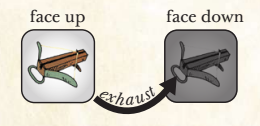
I'm imagining you flip the items over to show that they're damaged. Inspired by the board game Root.


Your items are stored in up to 12 inventory slots labelled 1-12. Whenever you damage your items, you roll a d12. If it hits the number of a slot that holds a damaged item, that item riots. It goes out of your control and starts acting against you.

There would be a whole table for this in the final rules. Souls could fire off randomly, or take possession of you and begin forcing you to do things. You could become trapped in a memory and unable to tell what's real. Weapons could misfire, items could fall out of your pack and roll away from you. Etc etc.

Your inventory should feel loud, vibrant, chaotic. Always whispering to you as you play.

HP would be very easy to heal - A short rest of a few minutes would heal d6+1 HP. Inventory damage would be your "Meat damage", more serious and hard to recover. Perhaps a long rest would heal d6 slots worth of items, or possibly you'd need to head back to a friendly goblin town to repair.


AND MORE


I'm imagining a huge variety of items which would act a bit like Feats, GLOG templates, or special abilities in other games. Possible options include:
  • Stolen Beauty: Mark 1 use to gain Advantage on a reaction roll (roll 3d6 and take the highest 2 dice).
  • Stolen Voice: You have stolen someone's voice. Mark 1 use to mimic their voice perfectly for an hour. You can pass yourself off as that person with a successful Charisma check.
  • Bottled Luck: Mark 1 use to re-roll a natural 1 from you or an ally.
  • Dream of Falling: Mark 1 use to cancel all damage from a fall.
I'm thinking abilities like this would be fairly rare, something you only get after a major milestone or quest.

Potentially you could even increase your basic stats with items like this, like "Stolen Strength: +1 STR". If I went down this route, I could replace levelling up completely with the inventory system.

Gaining a level could simply give you +1 or +2 inventory slots (which would also, elegantly, give you more health and survivability). All the other aspects of levelling up like increasing your stats, getting more skills, gaining special abilities, etc - it would all be done with items. I'm very tempted by this idea.

The neat thing about this is that it puts the character customisation choices in the game itself, rather than in choices made outside the game. If you want to be strong, you have to hunt down a strong person and steal their strength. It's not a matter of choosing a specific feat in-between sessions, or making a choice in character creation. It's a choice that you made and carried out in the game world.

MONEY


Potentially the Spirit currency could be years. Each coin represents 1 year of your life. If you lose your last coin, you are fated to die within the next 2d10 days.

But, I equally like the idea of focusing on a barter system with no currency at all, to move away from standard D&D money systems. Needs more thought.

APPENDIX N


This system was partially inspired by the GLOG hack BONES.As I was writing it, I was also surprised to see this post on Mental Encumbrance pop up. I guess great minds think alike.

Both BONES and the Mental Encumbrance idea have separate inventories for your physical items and your mental items (I.E. Spells, skills, and intangible notions). I experimented with this idea a bit but in practice, I found it wasn't giving me the tough choices I wanted. I found I could carry heavy weapons and armour in my physical inventory, and also carry a ton of spells in my mental inventory. I didn't have to choose between them as much.

I like the idea of having all these things take up the same inventory. It's simpler, and forces you to make more interesting choices.

TO BE CONTINUED!?


I have a lot more ideas about the overall structure. Basically, the game would be focused around factions. Each faction would come with a list of unique items which you could either steal from them, or gain as quest rewards. You would work with or against these factions to earn unique items and improve your character. But I'll have to elaborate further in another post.

I'm not sure how far I'll go in developing this idea, but I'm interested to hear what people think. Let me know if you have any feedback or ideas in the comments.