Summoner


The Cleric class assumes that your setting has a very specific type of god. A noble and benevolent deity that loves healing and nature, and constantly fights against corruption and evil. An ever-present, all-knowing and all-loving god. A Christian god.

I've never played a game with this kind of god. I've had savage, thoughtless gods, whimsical trickster gods, cold and absent gods, pagan pantheons holding gods of every color - never a Most High God. Growing up with Christianity everywhere, my group finds Him pretty boring. I haven't played around much, but it seems like a lot of the blog-o-sphere must feel the same way. The gods I've seen take more inspiration from Moorcock, Vance and Lovecraft than from the bible.

People still play Clerics, of course, so I shoe-horn the Catholic stuff into my weirdo gods. My goofy crocodile trickster god gives his clerics the power to heal, help others, and destroy the wicked, as does my dual-aspect insect god. So does Zak smith's Grim, Gaunt God of Iron, Rust and Rain. So does every one of these, I assume. Maybe the evil gods get to be Catholic Satan instead.

DCC has a slightly different problem. Whenever a DCC cleric fails a spell, they incur disfavor. This disfavor builds up over time, making them more and more likely to suffer the wrath of their god - until they take a rest for the day, whereupon it resets to 0. So, along with the catholic baggage, all gods are now crazed, wrathful avengers with the memory of goldfish. They get pissed off whenever you use the spells they gave you, only to instantly forget that on the next day.


There's nothing wrong with playing a game with catholic gods - even blind, angry ones. It's just that making every god with a cleric the same is a terrible waste. So here's my alternative: A Summoner. A more pagan kind of Cleric that's in communion with all the various demons, Fairies, Loa and Jinn that span this wild world. You can use them instead of a Cleric or side-by-side.

Commanding the Spirits


Every tree, forest, ocean and mountain has it's own spirits. As a summoner, you can command them. Use the same stats as a Cleric, but gain a Summon Slot every level instead of a spell slot. This lets you make a pact with a new spirit, which you can then summon at will. (You can play out tracking down and binding of this new spirit, or just automatically gain it - DM's choice.) You roll a Command Check to order these spirits  around.*

Command check: Roll d20 + your WIS modifier + half your Summoner Level. 


The check is 10, +2 per level of the spirit. So you need 12 or better to command level 1 sprites, 14 for level 2, etc.


If you succeed, you can give them a single command - usually a normal action, like "Go here and do this". Once it's completed it's task the demon may disappear or sit around to watch the show, but you'll need to re-roll the Command Check every time you want to give them an order.


Whenever you fail the Command Check, you gain one Disloyalty. This adds 1 to your Critical Fail chance for Command Checks, representing the weakening of your bindings. Disloyalty builds up over time, resetting when you sleep. If you ever critically fail a command check, one of your spirits will burst free of your bonds and start causing havoc.

While free, a spirit adds their HP to the Command Check needed to bind them. You'll need to wear them down, then succeed at a Command Check to bind them again.

Healing

Drink, Drink!

You can sacrifice your servants to sustain you and your companions. Roll a Command check and order your minion to let the afflicted party drink of their blood. A level 1 sprite heals as "Cure Light Wounds", level 2 blood acts as "Cure Serious Wounds", and level three is "Cure Critical Wounds". Once you do this, you won't be able to summon them for the rest of the day.

When you get up to a high enough level, you gain enough control over your minions to bind them into objects, or even dead bodies. To do this, you need to be 5 times the level of the spirit - level 5 Summoners can bind level 1 spirits, level 10 summoners can bind level 2 spirits, etc. (For DCC, it's 2X the level of the spirit.) 


Patron

Arioch, Arioch! Blood and Souls for my lord Arioch!

You have one powerful Patron - your god, or a powerful demon. This spirit gave you your power, in exchange for your True Name. Your soul will go to them when you die. It's up to you whether this thought fills your days with joy or wakes you up in a cold sweat every night.


You can call on them for Divine/Infernal Intervention. Roll a Command Check. A 10 gets you the simplest request possible, 12 is useful, 18 is incredible, up to an apocalyptic 30. The power of them entering this world makes the spirits restless, and weakens all bonds; add +10 to Disloyalty when you summon them.

Spirits for the rest of the party


Everyone can ask the spirits for aid, even if they can't actually summon them. You can find, make or buy charms dedicated to Gods, Demons and Sprites, and roll a Command check once per day to ask one of them for help. For non-summoners, that's d20 + your Wisdom modifier. Like Patrons, you can make a request equal to the number you rolled - 10 for the most useless thing imaginable. What they can do depends on the spirit - a sea god could protect you from drowning, but be useless against fire.

NPC's will typically ask for good crops, help in childbirth, or protection from barnacles on the hulls of their ships. PC's will likely want something more obvious, but the effect will always be passive and invisible - a bonus to dice rolls, better AC against unholy creatures, protection from disease, that sort of thing.  


You can get a bonus to your command check by making offerings to the spirit. Tropical Loas love candy and rum, fairies love music and houses of cards, Christian gods want dedicated worship and acts of goodwill. You can use this to become a kind of paladin - dedicate yourself to a god, make their sacrifices and wear their charms to get their aid with your fighting, thiefing, or magic-using.

The old gods have no power in the South... You may find that your charm's power wanes as you enter the territory of a foreign god. Suffer a -1, -2, etc to command checks for amulets as you get further in to those hostile lands.

*Next up: A full list of spirits you can summon. 


Appendix N: Dying Earth, Elric, the Wizard-Knight books, Clandestinauts, Pokemon.


Something weird

In classical D&D, almost everything is uncertain. Your best attack will miss, your best defense will fail, and everything always has a five percent chance of turning into slapstick at any moment. In this crazy world, there's only one thing that amounts to a hill of beans:

Magic.

— Angus McBride

Magic is the one pillar of sanity and reason in a world of 50% fail chances. It's the only thing that will reliably work exactly the way you want, at exactly the right time, every time. The best thief in the world can fall off the roof, the best fighter can fling a sword off into his pal's head, but even the lowliest wizard is in complete control of every aspect of his unearthly powers.

Isn't that fucking weird?

I think DCC is a good step on the road to the mythical Perfect Magic System on the hill, and I'm going to try to keep climbing a bit in the posts to come.

DCC Magic for the rest of us.


I love the chaos of magic in Dungeon Crawl Classics, but if I look up another spell table I'll go insane. Here's a simple version for you folks at home.

To cast spells, a wizard must roll a spell check. Roll a d20, add your Intelligence modifier and your level as a Wizard, and try to beat the spells difficulty. That's 12 or better for a level 1 spell, 14 or better for a level 2 spell, 16 or better for level 3, and so on.

If you succeed, you cast the spell and keep it. If you fail, you lose the spell for the day. On a natural 20, you get some incredible super version of the spell. On a natural 1, the spell backfires hilariously and you become hideously corrupted. The DM should just make these critical spell effects and mutations up on the spot, taking into account the context. DCC has plenty of examples, and you can use The Benefactors for inspiration.

Clerics are slightly different. First, they add their Wisdom/Personality modifier to spell checks instead of Intelligence. Second, when they fail, they incur Disfavor from their god instead of losing the spell. Disfavour adds 1 to their critical fail chance for spells. When they inevitably end up critically failing a spell, their god curses them. Make up some terrible fate based on their god.

A cleric spends all day pissing off her god, and all night trying to patch things back up again. Clerics can get rid of disfavor by pleasing their god with sacrifices and the like, and all Disfavor disappears if you spend your normal 9+ hour rest in deep meditation and prayer.

— Ken Kelly
The Elemental

Magic-users can improvise special effects for a spell, in the same way that a fighter can improvise exciting ways to stab someone. Say, set the ground on fire instead of sending out a Fireball, using Turn Unholy to destroy demonic artifacts or Sanctuary to stop monsters from entering a room. Anything that fits in with the general feel of the spell is fine. Just raise the spells difficulty by 2, 4, 6 or more, based on how hard the thing they're trying to do is. EDIT: or you could use this called shot mechanic. Raise their critical fail chance and lower their critical hit chance. The crazier the thing they're trying to do with it, the more likely it is to misfire.

This is my favorite idea on this page. DCC has a lot of spells like "Force Manipulation", which could give you an invisible weapon, platform, blockade or manservant, depending on your roll. The variability is great, but having it depend on a roll sucks. This rule makes normal spells as free-form and weird as they are in DCC and gives power to player creativity instead of forcing them to look shit up in a book.(!!!)


All spellcasters have friends in high places. Wizards can call on the despicable beasts they've made obscene pacts with, and Clerics can call on their Gods. If they want to ask their pals for aid, have them roll a spell check as usual. They can ask for a favour as good as the roll allows; beat 5, 10, 15 or 20, where 5 is a minor boon and 20 is apocalyptic. Wizards will of course have to satisfy some dark price later on (again, see The Benefactors). For Clerics, asking their god for Divine Intervention incurs +10 to Disfavor.

(This means that clerics will generally ask their god for help at least once a day, while Wizards will avoid getting in debt to their Patrons unless they can possibly help it, and then wish they hadn't for the rest of the game.)

You can use this system to DCC-ify spells from other versions of D&D. Vancian spellcasters should get all their spells, instead of memorizing a set number of them per day. This may seem like a lot, but that high failure rate means they'll lose plenty of them without casting them. Clerics and wizards should both start with about 4 spells and get one more per level.

On adding your level to spell checks: in DCC, level 10 is the max. Adding 11-20 to a spell check makes the whole thing a little redundant, so you might want to consider giving out that +1 to spell checks every second level if your system goes up to 20.

Professor Quercus' Qorner


Some advice from one of my players, the wise Professor Quercus.

"Your problem is that you love us too much. You claim to be a PC killing maniac, but it's all talk."

"There's too many of you. I am weak. You all gang up on me."

"Of course we're going to fight you, we're spoiled children. You have to take a firm hand with children."

He's right. Conversely, I have some advice for players: Take off the black hats.


"Black Hat thinking" is criticism. Poking holes in an idea. Like, when I say "You open the door and a monster bursts out of the room!", someone who's got their black hat on asks "How did the monster get in there? What has it been eating? Why would it want to attack us?"

I don't know about you, but this happens to me all the time. I'm in creation mode, trying to make interesting stuff as quickly as possible in front of an audience, and my players are in problem solving mode, trying to find a way around my obstacles. I'm naturally going to leave a lot of gaps, and my players are naturally going to pick up on them.

If you can talk your way out of the plot hole, this might work out. Say: "Uh, the monster has a slave-race of tiny fungus-men that do nothing but bring it food all day." So now instead of a plot hole your players have an interesting thing to interact with, and your world is a little bit better.

No matter how you handle it, though, this always sucks away momentum in the same way that blocking does in improv theatre. When you critique like this you're taking energy away, not adding it. When the GM has to stop and think up an explanation, all the momentum he built up from that monster introduction disappears. Building up that momentum again is hard.

A GM is constantly giving energy to players by making stuff for them to break. For D&D to work, the players need to constantly give energy back. They do this by putting on funny voices, coming up with exciting plans, making jokes, and stabbing people in interesting ways. The best type of player gives out massive amounts of energy, to the DM and everyone else.

If you sit in the corner and don't add anything, then you're not giving the GM any energy - but you're not taking any, either, so it's sort of ok. If you wear the black hat, you're not adding anything, AND you're forcing the GM to spend more energy in making up more things. If you're wearing nothing but the black hat, then you're constantly sucking energy from the GM and giving out absolutely no energy of your own. This is the absolute worst kind of player.

There's a lot of writing out there on how to be a better GM, but not a lot on how to be a better player. If you're the kind of person who reads this blog you're probably already the raddest player possible, but I thought it was worth trying to articulate what kind of responsibility a player has.

How to get to the Dwarflands - Part 2

From Thief Town to the Seventh Pillar


In a molten sphere in the center of the earth resides the dwarfish deity, the Most Low God. He is circled by six concentric tunnels that stretch the circumference of the earth. An enormous stone cylinder moves through each of these tunnels, rotating around the Most Low God. These hollow cylinders are called the Pillars, and the Dwarves make their cities inside them.*

The Dwarves judge time by the rotation of these pillars. Once every cycle the pillars align perfectly, and it is possible to walk straight from the first pillar to the last. It's a time of celebration, but also of judgement. Each dwarf is evaluated on their actions from the past cycle, and moved up or down the pillars based on their merit. Within each pillar, Dwarves are strictly ranked - come the Alignment, the kings of the upper pillars descend to become to beggars of the pillars below.

Sixth Pillar


"Sa’ah". Destroyed long ago. The only remains are the giant tunnel that once housed it, and the ruins under the bog of thief town. The thieves have stripped most of the treasure clean, but there's a ruined dwarf-house that still stands in the darkness just beyond thief town, guarded by some kind of tentacled barnacles.

There is an intact passage under the throne of the thief king that leads down to the lower pillar.

Fifth Pillar


"Hatma", a great bazaar where the majority of dwarvish peasants live, work and trade. All dwarf children live here in great, squabbling orphanages.

Fourth Pillar


"Nati", the great furnace. This is the heart of dwarvish industry, a constant heat of blacksmithing and building. Through some curious process, they are able to use fires without producing smoke.

Third Pillar

"Saqar", the perfumed garden. All dwarven women reside here until they are ready to be married, tending the vast subterranean garden that feeds all Dwarves. Dwarfmaidens are said to be so beautiful that glimpsing even an inch of their flesh unprepared would kill a man instantly, so they must wear full black robes while away from the third pillar. They reveal themselves to their lovers inch by inch over a period of months, until they can view them entirely without being destroyed.**

The pillar holds troops of إنسان آلي, automated men which work for the comfort and protection of the ladies. These machines are ingeniously designed to pour tea, offer towels and water for hand-washing, or play short pieces of music. There are also scattered monasteries, where those chosen to ascend descend to the second pillar must spend a cycle meditating and fasting.


Second Pillar


"Jahim", the pillar of Glory, city of the dwarf kings. The greatest of the dwarves reside here, raised to the second pillar by the judgement of the Most Low God. These are typically the greatest philosophers, scientists, leaders and priests of the age, along with those judged worthy enough to serve them.

The workshop of Al-jazari is here, where he works on the most beautiful and terrible of his automated war machines.[1][2] So too is the head church of the Dwarf Pope, known as the First Eye of the Most Low God, who sits in judgement of the deeds of each dwarf. Below him are the Million eyes, priest spies said to infest each pillar and report on the actions of every dwarf.

One of the most fearsome of Al-jazari's mechanical war beasts.

First pillar


"Hawia", the pillar of Faith. A vast labyrinth that holds the seven monstrous children of the Most Low God, along with their jinn servants. All dwarves must make a pilgrimage here at some point in their lives, to worship at the feet of one of these so-called Angels.

1. Lolth, the spider queen. Her servants are the Drow.

2. Gloria of the glass, a transparent maiden who can manipulate minds and memories. Her servants are the Shards. They carry glass books, which can absorb minds to be fed to their mistress.

3. Bahamut, an enormous fish with an elephant head, said to hold up the world. He has no servants.

4. Al-Qaum, a pillar of blood with three faces embedded within it. These faces change to become the mother, father, and eldest child of whoever views it. His servants are the skinless children.

5. Almaqah, an enormous penis made of vaginas. The dwarves have sworn this isn't a joke. It's servants are some kind of women with bellies that distend, wormlike, opening onto rows of teeth.

6. Malakbel, a collection of 700 golden masks grouped into a hoovering sphere. Each mask whispers secrets constantly. Her servants are headless men.

7. الحصان الساق, lit. "Leg horse".

Seventh Pillar


Jahannam, what we call the outside world. The Dwarves believe that our surface world is actually another pillar, enormous, but still underground. The stars and sun are merely holes in the roof of the pillar, where sunlight shines through from the true above ground. In that realm above sits the Most High God, the source of all evil.

As the farthest pillar from the Most Low God, the Dwarves consider us the most evil. The Dwarves that live here are the damned, outcast from every other pillar and forced to walk under the rays of the Most High God.

*I have written this story as it was told to me by the Dwarves, but the distinguished reader will be able to see the holes in it themselves. As Bomgumblewitz is the only true god, this Most Low God cannot exist, and the lower pillars of Dwarfland are doubtless empty.

**The dwarves describe their women as "like precious gems and pearls in their splendor, their clarity, their purity, and their whiteness." They have full black eyes, and b
linding white skin, "so delicate and bright... that you can see through to the bone marrow on the delicate flesh of their legs."[1] Obviously this does not match with the Dwarfmaidens we see above ground. The dwarf men explain that this true state slowly fades as a woman spends time away from the Garden, which is why all women must gather at the third pillar once every cycle.

How to get to the Dwarflands

The Dwarflands lie beneath the Dying Desert. There are many tunnels, wells and caverns that lead there; this is the fastest route I've discovered. Other routes may be safer, but lie deeper into the desert, where the salamander packs flow like waves.

Part one: From Snake-Eye to Thief Town


Snake-eye is a small village at the edge of the desert, so infested with snakes that their local oasis is composed of 2/3rds venom. The locals drink this poison as water. Pure water itself is poison to them; the local apothecary will make you pay through the nose to get it, so be sure to bring your own supplies, and be careful to conceal them from the town guard.

The Snakers have a curious finickiness about showing skin, perhaps inherited from the dwarves below them. During the witching hour, it is forbidden to view any flesh at all. For this reason they sleep in long burqas, and close the whorehouse at 11.1 Conversely, you must bare everything before the eyes of god and the law. Everyone goes naked in the Snake Temple, which doubles as the towns' church and court-house. Thus, even the most boring trials receive massive audiences.

Under the village lies the true heart of Snake-Eye: Thief Town. The thief lords of the desert use underground caverns to smuggle goods everywhere under the sands, and Thief Town is their base of operations. Snake-eye acts as the above-ground cover, and it's true nature will become obvious as soon as you enter the swarming crowds. Anything you haven't nailed to you will be stolen, to be taken and sold in Thief town. Don't try to go to the guards: they're all corrupt.2

Your only hope of retrieving your belongings is to track them down to Thief-town. There are many secret entrances in the dry wells of Snake-eye, but they're often guarded, and the passwords change weekly. Your best bet is to befriend a local. If that fails, try barging through into the back room of the Asp Hole (the local inn). Descend the ladder there, and then cross through the tunnel below, stepping on the lettered tiles in this order: S, E, S, A, M, E.

Below is an enormous tunnel, perfectly circular, that stretches through the entire length of the desert.4 It's large enough to house a city. Instead, rickety wood ladders and platforms are lashed to the walls in a massive, decaying network that extends down to the twinkling lights of Thief-Town below. Crouch low to the wood as you climb. The ladders are infested with a debased species of lizard-dwarf, which love to leap across and pull travelers down into the dark.

Those able to communicate with these savages may gain access to their home platforms5, which hang in the center of the tunnel from a thread of some strange secretion. Their eggs litter the bottom of the platforms, stuck upside-down. When they hatch, the younglings fall to the ladders below. They swarm there, devouring anything they can, until they gain the strength to climb up and join the adults. The ground of thief town is a bog, fertile with the decaying corpses of lizard younglings: only the strongest climbers survive.

The houses and walkways of Thief Town are raised on stilts and lit with torches. The population is mostly Dwarves, evil or mutated7, exiled here from the lower dwarf lands. Thieves of every color ride here in centipede caravans to fence stolen goods from everywhere in the desert. If it's stolen, you can find it here. If it's not, they can get it.

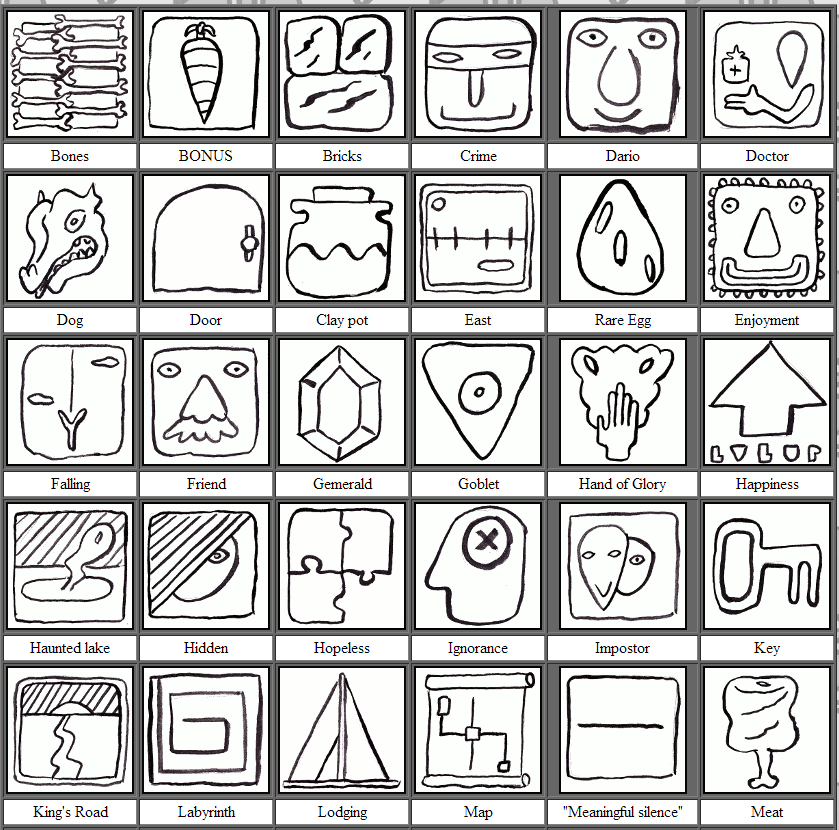
Gold is king, of course, but Card Wars is god. The thieves play it religiously; a master can win a lot of loot without spending a cent. Trick is, the game doesn't appear to have any rules. Players place down cards in intricate combinations, then explain themselves. "Dog and Door," grins one, "That gives me five gemeralds and places the moon in blood quadrant, upgrading my eyes to diamonds." "Clever," responds the other, "But   you've left yourself open to my Hidden Imposter!" Neither will admit to making it up on the spot. The better bullshitter wins the day.

Cards must be stolen or won off other players; I've reproduced a selection below.


Full card list here - open "How to win at Goblet Grotto.zip" and then "Glyphs".


Thieves whisper that the game is more serious than it may appear. It was invented by the first Dwarves,8 in honor of their now-forgotten gods. Those gods still linger and can always be called to judge a match of their favorite game. Spit and swear "D'hol Kha-ti" ("I take this duel to the shadow realm"), and the stakes of the match will be enforced by their watchful gaze.9 The Thief King is said to be particularly fond of this past-time. His house is surrounded by torn souls, flapping on stakes - gamblers who were ripped apart by the old gods when they could not satisfy the impossible stakes he set.

Next: From Thief Town to the Seventh Pillar of Dwarfland


1 I've heard rumors that snaker flesh transforms monstrously during this hour. I tried to verify this, but the woman fled at the last minute.

2 If you happen to kill one of the guards,3 check their mouth. They keep all their money hidden there as teeth, and the richest guards will have grins of pure gold. Take care, though: many of them place booby-traps, set to explode with acid as soon as someone pulls out the wrong tooth. You can visit the local dentist if you wish to take similar precautions.

3 There is a rickety section of flooring in the lower cells of the jail that conceals a small hollow. It can fit two bodies, in a pinch.

4 And, if the dwarves are to be believed, the world.

5 The effort is well worth it. The lizards keep packs of chariot rats with the uncanny ability to cling to the walls and roof of the tunnel and run as if they were right-side up on solid ground. I managed to win a pack of my own in a game of Card Wars. They also accept barter; animals or men. 6

6 Whatever you do, do not allow the rats to gain a taste for man-flesh.

7 That is, more than four feet tall.

8 Or the first thieves, or both.

9 Never do this over ancient graves, or anywhere the forgotten gods have more than a flicker of power.

Dangertopia!


Yeah, I'm finally posting it. Click this link to get a wilderness swamp zone encounter pdf, fit for all your weird adventuring needs.

Dangertopia! A riddle and a curse!