Showing posts with label negadungeon. Show all posts

Megamall23, week 1: The Avenue


Here's the start of my Dungeon23 project. I don't think I'll be able to post an update here every week, but I wanted to start out with an update. 

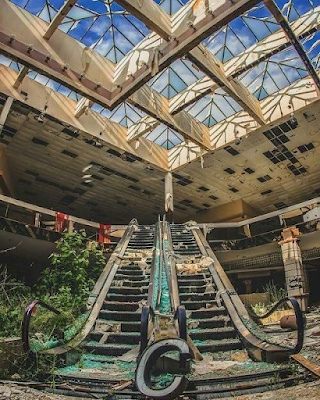
I stole the layout of the real American Dream mall and cut it into rough dungeon sections to get me started. I decided a horizontal layout would be best. Not only does it evoke an actual Megamall better, it also helps make sure the space is naturally jacquayed. This space automatically has a lot of entrances and connections between sections. The players immediately have a lot of choices about where they want to go. 

MEGAMALL23


I am joining the dungeon23 craze. If you haven't heard of it, Dungeon23 means writing 1 room of a dungeon each day, every day in 2023. My project will be an dying cyclopean Megamall in the same modern horror setting as these monsters. 

This vast decaying megamall has lain outside your home town for as long as you can remember. Your parents remember the days when they used to shop there. You grew up with stories of the wondrous things they bought. The light and sound and colour. The air inside smelled of popcorn and sweet syrup and caramel. It was a magical place. A dream.

Things have changed. The lights flicker and fade. Huge sections of the mall lie empty and dark. Sometimes you think you can glimpse unknown constellations or planets inside the glass domes. Twisted shapes scuttle within. But still, people come. They flood into the mall from all across the country. They can't help themselves. They dream of it. Perhaps somewhere inside, they can finally buy the answer to all their problems.

Towers


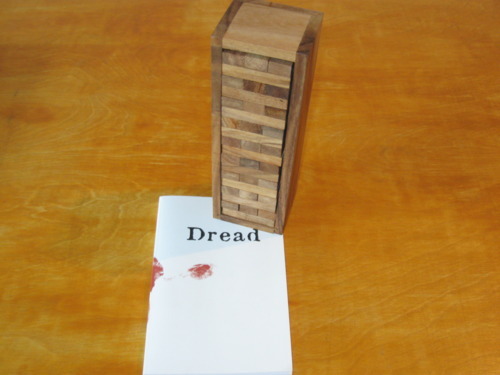
I've been reading the RPG Dread. It's a horror game, where you must pull a block from a Jenga tower whenever you make a risky action. If the tower falls, you're removed from the game. It's such a neat little idea that I'm planning to make my own tower, based on Tartarus from Persona. 

Instead of removing blocks to make risky actions, you add them. The tower slowly rises in front of you. I prefer this metaphor of the dark tower rising - more ominous. Eventually, the tower naturally becomes too unstable to hold any more blocks. Here's a test I made out of houses and scraps from Mystery Teens. You choose blocks at random, so every tower will be different. In this test, the tower tumbles at around 11 blocks. I'm not sure what the sweet spot should be: 30? 20?


The big bonus of building the tower instead of tearing it down is that there's no setup time. Whenever someone dies in Dread, you have to rebuild the tower and pull some pieces, so the game has to screech to a halt for a setup break just as it was getting interesting. This tower is meant to start in pieces, so when it falls you can keep on playing without a pause.

I'm planning to use this for my game Mystery Teens. Whenever you take some time or risks to find a clue, you place a block on the tower in the center of town. None of the adults can see it. You can open up each tower block (if you can manage it without making it fall) to find strange and revelatory dream cards. When the tower falls, you've reached the climax. Hope you've figured out the solution to the mystery, because the villain's plan is currently boiling out of the moonlit suburbs like an exploding black octopus.


Here's another thought about Dread, though:

Motivation in Dread

Dread characters are made by giving you a questionnaire with loaded questions like "Why did you kill your wife?" After listening to this full play recording of Dread, I've decided every Dread questionnaire needs one extra question: 

What do you value more than your life or sanity?


The DM on that podcast explained that every block pull is optional. Even when a madman is swinging an axe at your head, you can still choose not to pull the block - it just means you've chosen to fail. Choosing not to pull a block means you can't be removed from the game, but the Host can do whatever they want to your character in exchange. 

Reading through the Dread rules now, I'm not sure they support that reading. I love it anyway. Whenever dark and terrible things happen to their characters, it is crucial it's their own fault. Like I've said before, they need to choose to go into Silent Hill or Death Frost Doom. If you force them to die, it's arbitrary. They're just frustrated at you, not blaming themselves.

Now, in any game with dice, this is hard to get right. It's easy for something horrible to happen to a character just because they were unlucky. You have to design against this possibility, working against the dice, making sure everything can be anticipated and foiled before the dice come out. Conversely, the tower in Dread makes sure that every death is the players fault- that's just how the system works. If you don't want a consequence (losing a limb, going nuts) you can always pull. If you don't want to die, you can always choose not to pull. Death always comes at your own hand.


So it's wonderful that Dread makes players to doom themselves, but by default the choice to risk death doesn't feel interesting to me. In the play recording above, their goal is just to Survive. As a horror game, I assume that's the goal of many Dread adventures. But when that's your only goal, most block-pulling choices boil down to two options:

A: You pull a brick, and risk being removed from the game.
or
B: You refuse to move the story forward, and suffer some consequence that makes it seem like you're more likely to be removed from the game in future.


This choice seems interesting in the moment: Do I want to risk death, or get a broken leg for certain? But it's fake. If you choose B forever, you'll never die. If the goal is simply to survive, you just need to always pick B. When the obvious best choice is to do nothing and refuse to move the story forward, something is wrong with your system.

To solve this problem, you need to give the players a goal other that survival: Something they value more than getting removed from the game. The wonderful thing about the Character Creation system is that you don't even need to decide what this is - you can ask the players themselves. Maybe they decide their character would sacrifice their life for their family, their honor, their country, whatever. You can then take those answers, and put them at the end of the adventure.

Now that value will be put to the test and strained to breaking point. At every step of the adventure, as the tower gets more and more unstable, they need to decide - do I really care about this thing? Am I really willing to sacrifice death for it? That's an interesting choice. If they decide no, and flee as their family is slaughtered, that's a fantastic character moment that'll make them great to play in future games.

This is so perfect for getting that Doomed Obsession that I'm crazy about. James Sunderland, looking for his dead wife. The journey to find Colonel Kurtz. Getting the players to give you the rope to hang them with. It's lovely.

Negadungeons

Uzumaki Chapter 19 Page 1
If you play in my games, don't read this.

Well, my old post about The Negadungeon blew up for no reason this weekend. There's praise, criticism and some charming folks who came to appreciate the concept even though they'd never run one. People are talking about the post in polish and german. Who knows what they're saying? Not google translate, that's for sure. The concept has grown bigger than me, and ancient. I see people who assume they've missed the long history of the term, and speak like it crawled out of the primordial soup in the 80's as a leech on D&D's back.

A few people seem to read the thing as a glowing review of James Raggi's LOTFP adventures. That's not quite accurate: This is what I believe these adventures aspire to, the reason why James Raggi does things like curse the PC's as soon as they look at the dungeon. It's an ideal, not a documentary, in the same way that the Old School Primer isn't a literal description of how people played in the 80's. The adventures themselves often fall short of the mark for me.

The most obvious problem with the concept: the DM prepares a Negadungeon, and the players sensibly take one look at the thing and decide to run for the hills. As in this review of Death Frost Doom, where the DM forces an unwilling set of players to complete the module, or this session report where the players flee Tower of the Stargazer and the DM has to improv the rest of the session.

                              Uzumaki Chapter 19 Page 13

The interesting thing is that I haven't heard this complaint of horror modules for Call of Cthulhu et. al. Any sensible PC would take one look at any horror adventure, call the police, and fly out of the country. They don't do it because they know what they're here for. The DM has made a horrorshow, they've made PC's for it, everybody's gathered around the table with the understanding that the PC's will fling themselves into the terrible situation at hand like the characters in a horror movie.

I think this is the greatest problem with Negadungeons, but also the greatest source of potential. The obvious thing to do in making this killer dungeon would be to force the players to do it, right? Lock the door behind them, or put it on the table and say "We're running Death Frost Doom tonight, everybody get ready to die." - the approach that makes Call of Cthulhu work. But the approach Raggi takes - where the players have to actively seek out the place, often in the middle of a campaign, and push past the people trying to stop them - has the potential to make the players responsible for their own doom. They weren't forced into it.

I'll give an example. Spoilers for Spec Ops: The Line.


The Line is a video game that pretends to be a Call-of-Duty power fantasy. It's a trap. As the game goes on, it slowly turns into a Negadungeon. The turning point is a scene half-way where the player commits an atrocity. After that, you start dying, going insane, flying down the slippery slope to the point where you find out it was all for nothing. The player is meant to feel horrified and guilty for all this. Loading screen tips start saying "This is all your fault."

The problem with this guilt-trip is that it isn't the players fault: If you want to play the game, you need to commit the atrocity. (The game's writers claim your choice here is to turn off the game and walk away: this is the good ending.) This is analogous to playing a horror module: You force yourself to make the bad decision because you've paid for this game/your DM has paid for this module. You're making a meta-game decision that leaves you immune to shame and horror. Of course this isn't your fault: You just wanted to play the game you paid for.

The potential with allowing the players to walk away is that it is their fault if they commit the atrocity. Having a genuine choice means the PC's can feel genuine guilt, knowing that they were sent down this spiral because of their own greed and doomed obsessions - not because you wrote "You have a doomed obsession" on their character sheet. You haven't shot them in the head: You've just given them the gun and allowed them to shoot themselves.

Of course, pulling that off is going to be difficult. In practice, Death Frost Doom relies on a cheap trick to get the players to orchestrate their own doom. It should be their greed that bought them down here - but it's more likely that they just felt like they had to play the adventure their DM prepped. They'll fall for the trick either way, and they probably won't feel like it was their fault.


If I made a Negadungeon, I would make the one discussed in this thread. The trick: it's a normal dungeon that can become a Negadungeon if the players make the wrong choices. If they don't take the bait, you still have a fun adventure to run through for the evening. Because you have that fallback, the players don't feel forced to make decisions for meta-game reasons, and you haven't wasted your time prepping a dungeon they'll never play.

The Finder haunts/ These twisting hallways/ His sightless eyes/ Can see you always

I've realized not everyone can read the thread I linked. Here it is.

Cédric Plante originally shared:
 
I have sketched a Demon Horse Tower. Now I am looking for stuff to put inside to post it on my blog. 
Arnold K.
26 May 2014
+
1
2
1
 
Reply
 
I want to write up rooms and monsters for it.  You only have to make eye contact once to realize how fucked up horses are.
Arnold K.
26 May 2014
+
2
1
2
 
 
I would fill it with horses.

Slaughterhouse architecture: gently curving hallways, so the cows in the back can't see what's in front.

Railings that keep a gentle pressure on the side of the animals, so they remain calm.  Soothed.

Good drainage in every room.

Stairs for the animals to walk up, so they enter the process at the top of the building.  After their deaths, their body weight makes it easier for the meat to slide down/onwards.

You wouldn't even need to make the dungeon a slaughterhouse.  Just use the slaughterhouse as a unifying theme.  Put drains and rails and chains in every room, and eventually players will realize exactly what they are going to find at the bottom.
Cédric Plante
26 May 2014
+
1
0
1
 
 
I am taking notes, I will post some rooms soon. 
Jack Mack
26 May 2014
+
2
3
2
 
 
+Arnold K.  I agree that you don't want to go crazy with pig guts on all the walls and the like. Use the slaughterhouse stuff as a subtle omen, like the movie Chinatown.

Maybe people call the place The Slaughterhouse or Meat City - then you go there, and there's no meat, no reference to it. As you go up the tower all this stuff creeps in around the edges. People start making vague references to it, places are only described as "The Brain", "The Heart".

Also have an NPC who says "This world is a Machine. A Machine for Pigs. Fit only for the slaughtering of Pigs."
Arnold K.
26 May 2014
+
3
2
3
 
 
+Jack Mack You just referenced, like, two of my favorite things, and one thing that I intend to play.

NPCs should just refer to it as The Machine.

The bottom floor needs to be meat, though.  Like Death Frost Doom, except the final act needs to be fountains of gore and swinging meat hooks, etc.  And purple worms rising from the vats of ground beef.

Can you imagine being trapped in a small room with some pigs, and then the doors open and the pigs are running from ambulatory pig grinder machines?  You better run, too.

Maybe the trick to the dungeon is figuring out how to avoid turning it on.  Like, if you can get through the whole thing without activating it, it's pretty mild.  But once the Machine is on, every room becomes a death trap.  Every floor drain begins vomiting up blood and indian burial grounds.

And the further down you are when the machine activates, the more fucked you are, because you need to go all the way back out.  Unless you think you can make it out of the Meat Exit at the bottom.
Trent B
26 May 2014
+
1
2
1
 
 
NO FUCK YOU.
Jack Mack
27 May 2014
+
1
2
1
 
 
+Arnold K. yes, yesss.

I like the Death Frost Doom "no-one's getting out of here unscarred" thing, but you definitely need the doom be triggered by the player's decisions, and the central DFD trick is a little cheap.

I guess the whole place is ruined, and the more you turn on the machine the more you summon the old ghosts and bring back the gory days. The bottom floor has a few settings, from easy to horrific. Pulling levers on the way down opens up the place and disgorges ultra-valuable parts from long-extinct animals, but makes the meat god at the bottom worse and worse.

Maybe if you get too greedy, at the highest setting when the machine is coming fully to life with apocalyptic consequences, all those valuable animal bits start coming alive in your packs and joining together.

Some Negadungeons

In my last post, I summarized the content theory. Simply put, many game reduce everything you can experience to "Content", which is meant to be consumed and reward you for consuming it. Designing a game-world to make the protagonist happy leads to games with a naive and solipsistic world-view that is often at odds with their serious stories. Here are some games that reject or oppose that.


You take control of a girl in her room. She can sleep, play video games, work at her desk, or go out to her balcony. She refuses to leave.

However, if you go to sleep, you enter a version of your room where you can open the door and walk out. If you do, you find yourself in an enormous mega-labyrinth of interlinked dream-worlds. The core sense of horror and surrealism in these dream-worlds comes from the feeling that they are not made for you.

The game is about wandering, lost, through enormous broken levels. Some force you to walk through giant black voids without landmarks. Others confuse you with cyclical layouts that loop endlessly. You might find the exit by walking between two stones, or interacting with a flower an odd number of times. There is the feeling that you've fallen through the map, into broken geometry you were never meant to cross.

There are many pieces of content that were clearly designed never to be found: Genuinely secret secrets. One monster has a 1 in 47 chance of being summoned whenever you flip a certain light switch. One door opens if you pass it three times, then turn back.

More thoughts here.


Colorful little micro-worlds suspended in a terrifying black void.

Earthbound was one of the first games to capitalize on the casual surrealism of JRPG's. It discovered a rich vein of weirdness that has since been mined by everything from Space Funeral to Anodyne. The quests are bizarre. Like in a dream, your reasons for doing anything dissolve when you try to explain them.

At first this dream-like atmosphere feels warm and charming. Slowly, though, over the course of hours and hours, you begin to get a sense of deep malice. It's not something you can put your finger on - most examples I can give will sound like trivial frustrations. But as you go on, the logic of the dream world slowly transforms into a nightmare that you feel trapped in.

At one point, you are suddenly transported to Moonside, a  inverted version of the town you're traveling through. The buildings glow neon, the inhabitants slur broken speech at you, and pieces of abstract art constantly attack you, even indoors. Being trapped there is nauseating; even worse is the way you have to follow the broken logic of the place to escape it. Internalizing it's crooked rules feels somehow corrupting.

The game suddenly and randomly transports you to a terrifying inverse world like this twice in a short space of time. The effect is a feeling that this darkness underlies everything, everywhere. Later, as you navigate the dream logic of another quest, you start to feel like you never really escaped Moonside. 


There are flowers in the forest. A counter on your screen tells you how many you've collected, out of 144. If you collect all 144 flowers, absolutely nothing happens.

That is vicious. I can't defend it.


The "Good Ending" of Spec Ops: The Line is to turn off the game. The longer you continue, the more you descend into increasingly horrific and unnecessary war crimes. The content you consume is repulsive: the combat itself is deliberately designed as an endless slog that slowly numbs you to all sensation. The game wonders aloud whether playing it is a morally questionable act: "To kill for entertainment is harmless," reassures one of the loading screen tips.

It largely exists for people who play Call of Duty without questioning its values. The game was marketed as a straight Military Shooter: The box offers no indication that it will slowly and surely become a nightmare. I can imagine that it reached a lot of COD-playing twelve year olds, who must have been traumatized to find their escapist killing suddenly become messy.

A 50,000 word long discussion of Spec Ops here.

Horror games in general

If a horror game is at all successful, you won't want to consume content. The genre expectations completely invert the philosophy of modern game design. As soon as you realize that a game is a horror, you expect that consuming content will not be traditionally enjoyable. You judge that the game has succeeded if you don't want to fight the monster or enter the new level. This means horror games are celebrated for things that would be seen as terrible game design anywhere else. Thank god they exist.

Silent Hill 4: The Room in particular


You wake up in your apartment. The door is locked: There's a hole in the wall that leads to a nightmare. You slowly explore this nightmare world, returning to your room as a safe place to rest and heal. At one point, someone offers you an item. You can take it, or refuse it. Obviously, you're going to take it - that's the way games work. Items are there to be picked up. 

If you do, a nightmare creature invades your room. Your safe place is violated. Nothing is sacred, nowhere is safe.

More on Silent Hill 4 in The Gamer's Quarter, issue 1, page 26. The magazine is now sadly defunct, and I can only find a download on that website. 


I use this game as a modern stand-in for every classic RPG from fallout to the OSR way of running D&D. If you go to certain places, you will find monsters too terrible for you to fight. These places are not made for you: you are not welcome here. This feeling is temporary, of course: The games pretend that a place hasn't been designed for your benefit so that it feels all the more satisfying to come back when you're at the right level, and slot into your correct place.

The same feeling is captured in Metroidvania games. Classically, you'll have to jump around lava pits before unlocking lava-proof shoes. When you get that item, you've suddenly turned the world into something that's designed to be convenient for you. It's like turning a jungle into a department store with the flip of a switch.

More here.


The world is made for your enemies: You have to skulk around the edges of it, distort it to your own purposes, and penetrate it. 


So.

I worry that I haven't expressed this anti-content idea well, even after these two articles. It is, essentially, the idea that a game shouldn't make you happy: that the things in a game should not feel like they've been made for you; that the sickening feeling that you've done the wrong thing is just as valuable as a pat on the head. It's an advocation for games that are bewildering, broken, twisted and immoral. It stands alongside the philosophy of fun games, not against them. These ideas might be obvious, but they're important to the way I think about games. 

Negadungeon


For a while now, Lamentations of the Flame Princess has been pretty much single-handedly promoting a type of Inverse Dungeon, embodied in modules like Death Frost Doom and The Monolith. What separates these Negadungeons from normal adventures is:

1. Entering the Negadungeon is a mistake.

If you're in a Negadungeon, you've fucked up. Everything within will:

A. Curse you
B. Trigger traps
C. Unleash unspeakable evils
D. All of the above.

It is not made to entertain you; it is made to destroy you. It holds nothing but negatreasure and negaexperience.

Scholars debate whether or not there should actually be anything good at all within a Negadungeon. James Raggi's "The Tower" ends with the sentence: "There is no treasure in the tower". Certainly, the players need to believe something good can come of entering. It's up to you whether it's ok to deceive them.


James Sutherland enters Silent Hill because he's received a letter from his dead wife. That's the kind of thing that brings people to Negadungeons: Doomed obsessions. Everybody knows that finding his dead wife won't end well, even James. But he keeps going, because:

2. Once you start the Negadungeon, you're committed to finishing it.

I don't mean physically - the door should always be open behind you. But once you've entered, things can never go back to the way they were. Something has changed in you, or in the world. You're compelled to keep going, even though it just gets worse and worse the further you go.

Even if you leave, you act as one cursed. When you sleep, you'll dream of the Negadungeon, and wake with blood on your hands.

3. Descending is morally despicable.

It might start small - an old man tries to stop you from going down, and you have to tie him up. Next thing you know you're breaking the ancient seals, disturbing the dead, killing the guardian children. It's obvious that going down is bringing evil into the world.


In Dark Souls, a city was flooded to contain an ancient evil. To descend, you have to kill the last holy man and release the flood gates.

4. This is all your fault.

It's very important that the players decided to come here. You're not allowed to trap them in: They must trap themselves. They walked past the warning signs, they knocked over the guardian sigils. When push comes to shove they should be crying "Why? Why did we go to Death Mountain?"

The flipside of this: A Negadungeon is a great addition to a campaign setting even if the players never go there. Having a place that the players avoid at all costs is great.

Why would anyone enter a Negadungeon?

  1. Something was stolen from you and taken to the bottom. Each level you descend, worse things are stolen.
  2. Fell from a regular dungeon.
  3. To save a dead PC.
  4. Sick curiosity.
  5. Greed
  6. Looking for revenge

Why would anyone keep going down a Negadungeon?

The sunk costs fallacy.

You're cursed, Dave is dead, the zombies you've unleashed are destroying the countryside. "Well, we have to keep going, or all this will have been for nothing!"

At the end of the Negadungeon, you are allowed to reveal that the goal was useless, and it was all for nothing.

Edit: What's the point?

1. They're different, strange, and your PC's don't expect them. It challenges expectations, shakes things up.
2. They change the Risk-Reward template of a dungeon into a Doomed Journey; an experience like Heart of Darkness, Silent Hill, or this guys journal. That's a cool type of story to emulate.
3. Losing is fun.