Final Boss


I read The Laughing Vampire and it didn't measure up to what I imagined after reading this post. Now I desperately want to make the comic I imagined. The final boss crew, waiting for death at the top of the tower as the heroes slaughter towards them.

The pacing and style would be inspired by Absurd Theatre. You know, Waiting for Godot. More specifically this play:


It starts with 2 whole minutes of silence, which of course in this quick-flash internet age means it forfeits all right to your attention immediately. Try to stay awake if you can, though: The silence and trivial banter serves to totally immerse you in a claustrophobic box of growing tension and hysteria.

I want to put that waiting into a hyper-dense world of exploding ideas in the style of Kill Six Billion Demons, following the maxim of "Maximum Good Ideas per Page". The first step would be to sit down with an artist and create a bizarre world and characters in intense detail.


I think this could add to the Theatre of the Absurd in the same way that Cowboy Bebop added to the Western. 


I love long slow shots of a desolate environment, instilling the sense that the characters are small and insignificant flickers of life in a dead land that cares nothing for them - in theory. In practice there's only so long I can look at still shots of the desert without losing my mind. The pacing and style of Westerns doesn't work for me in this dry environment.


When those slow shots show fantastic inventive sci-fi art, though, I'm all in. Cowboy Bebop keeps the spirit of a western, but saturating everything with imagination elevates it for me. This is the way I am, I guess - I need a dose of pulp and wild ideas to make the medicine go down.

None of these ideas will be explained through exposition. One of the principles of Absurdism: We never talk about the important things on our mind, just orbit around them with trivialities. The characters take everything interesting as trivial and are obsessed with meaningless details. The comic dips you straight into the situation like a cold bath. You have to piece the background together. It echoes with hollow spaces and half-said things.

While I'm at it let's mix in some Lolita, let's make these people warped and despicable and seductive, and then submerge you so completely into their evil little world-view that you end up nodding along.

I think it would work something like this. I'm not sure about it, and I've never written a comic before.


A woman picks the wings off a struggling dragonfly with tweezers, then places them on an intricate sculpture of inter-weaved insect parts. 

Man: "Have you seen my shoes?"

Woman: "Hmm?"

Holding the sculpture in place with one hand, she searches through her things with the other and picks up a small bottle of liqueur.

Man: "Shoes. The black ones, let me walk into people. Seen them?"

She tips the liqueur over the sculpture, then reaches out for a match.

Woman: "What do you want them for?"

Man: "Well, I want to look presentable, don't I? I'm not going out to meet them in my bloody pajamas."

The woman sets the sculpture on fire. It twitches, then moves to join a small parade of insect-things. She smiles.

Doomed Obsessions

Death Frost Doom (PDF)

Before I started Death Frost Doom, I took each player into another room and gave them a secret objective.

  1. Last year, you/your wife suffered a miscarriage. Of late you have been haunted by dreams of your child, crying out, tortured in the pits below Death Frost Mountain.
    Your child's soul is held prisoner by Eizethrat Nexx in area 24. If attacked, she will send your child against you.
  2. Your parents told you that you trace your heritage back to the ancient kings, but an ancient death cult stole the Noble Seal that proves your right to rule. Rumours and legends suggest the seal was offered as sacrement to one of the black altars on Death Frost Mountain.
    Your seal is on the altar in area 22. The back is engraved with the symbol of the Duvan'Ku. It's clear to anyone who sees it that your ancestors were a willing part of the death cult itself.
  3. Your ancestor was a great saint of Vorn who went crusading against the evil in Death Frost Mountain and never returned. His body could be used to make holy reliquaries of great power.
    Your ancestor was transformed into the Sacred Parasite in area 22. He was corrupt to the core. He no longer has a body.
  4. Your god has commanded you to root out and destroy the evil at the center of Death Frost Mountain. It whispers to you even now, reassuring you that you're on the right path.
    Your god is silent. You are being spoken to by the thing chained under the mountain in area 22. It wants you to awaken it.
  5. You had some bad habits, but you're shaking them off and getting your life in order. You quit your addictions, stopped the rampages - now you just need to repay your old debts using the acres of gold hidden under Death Frost Mountain.
    You were addicted to Purple Lotus Powder. There's some in Room J.
  6. You live in the village under Death Frost Mountain, a descendent of escaped slaves from the cult. You're tired of being sick and poor and afraid. You want to take the power of the mountain and use it to protect and help your village. Your ancestor's diary speaks of the Grimoire of New Flesh - that'd be a good start.
    The Grimoire of New Flesh is in room 12. The thing you create will destroy you.

There's nothing wrong with the simple greed that's meant to tempt players into Death Frost Doom, but I like my negadungeons to be a little personal, y'know? My all time favourite adventure hook is "You get a letter from your dead wife." In retrospect, I think giving one of the players an objective that worked against the others would have worked out well, but I wimped out and decided to just make them believe there was a traitor.

The adventure went great! I had 8 players, including three women totally new to D&D, and they all walked away indoctrinated into roleplaying. The highlights were a conversation with a dead child, FINALLY getting to use my hireling table (which lead to a duel with a glovemaker in the middle of a fight with the Sacred Parasite which was flooding the room with ice - a PC trapped underneath a frozen corpse as the glovemaker rose above her with a knife), and the climax where one PC sacrificed another on a black altar as the dead closed in.

"Not a game"


Quick rant about videogames here.

There's a long-simmering Cold War over the definition of Game. The lines are split between "That's not a game" and "Yes it is", and if you're on the opposite side people will get angry at you. It flares up in comment sections across the internet. People won't talk to each other over this.

The origin story, as far as I can tell: One day, someone made a weird interactive thing. It was featured on a gaming website. Some loser came along and said "That's not even a game." Everyone who likes weird interactive things collectively responded to this with "Yes it is!" Some well-meaning academics bumbled in trying to get clear definitions, and are now eternal enemies with these people.

There's two statements in the phrase "That's not a game", as used by an internet asshole.

1. Games are the only worthwhile thing (to talk about on this website, to make, to care about, whatever).

2. You are not in that category, games.

In defending yourselves from the second statement, you've ignored the first. It's as if a bully said "What are you, gay?" and you tried to defend yourself by saying "No, of course not!". Both contain two statements:

1. Being in category X is bad.
2. You are in category X.

Defending yourself from statement 2 means accepting this value system, where category X is bad. And everyone has accepted this! It seems like most of the weird interactive thing enthusiasts now accept that if you say something is a game, you're praising it, and if you say it's not a game you're attacking it. Game dev Anna Anthropy won't talk to academic Raph Coster because he doesn't agree that dys4ia is a game. If anyone makes statement 2 (You are in category X) everyone assumes they've made statement 1, that they're talking about the value of the thing.  That's why anyone who's interested in definitions has gotten caught up in a blood feud.
Talk about an appeal to emotion. Isn't it fucked up that the weird kids, the people making the craziest stuff out there, have accepted the value system of the anonymous internet gamer bro they hate? That their bizarre, boundary-stretching thing is only worthwhile if you call it a game, of all things, instead of a poem or a story or a sculpture?

We need to go back to the root of statement 1: Should non-games be talked about on gaming websites, submitted to game jams, and awarded trophies at game events? This is the issue at hand. The definition of game is irrelevant.

I believe the answer is yes. No-one is going to talk about this shit except us. Check out this article. This guy made a hypertext story. He didn't think of it as a game: he posted it to the literature community.

"I think the most pages I saw any one person view was in the teens. Hardly anyone stayed with it for longer than a few minutes."

Then the gaming community found it.

In June, when the issue launched, and the literary announcements went out, the file that is my story was loaded n times.
In July, as of yesterday, the file was loaded 10*n times. 

But the really cool part is how much more time people who approached it as a “game” spent than people who approached it as “literature”. The game community page numbers were consistently in the 50-70 page range, and the highest individual number I saw was 104, by a person with a Munich IP address who spent 4 hours with it. There are some people who haven’t left it. They have simply kept it open in their browsers and once a day for the past week they add a couple of pages to their total count.

Whatever category this thing falls into, we need to be talking about it. Nobody else will.

Watch the Skies!


Just a heads up for anyone who follows this blog. I'm running a Megagame called Watch the Skies! As seen on Shut Up and Sit Down. You can sign up for it here. 

Leviathan

I've started a blog where you can read more about it here. I haven't had time to post much besides the map, but hopefully in the days to come I'll have a chance to post some more of the cool stuff that's going into making it, and the kind of theoretical game wafflings I normally push.

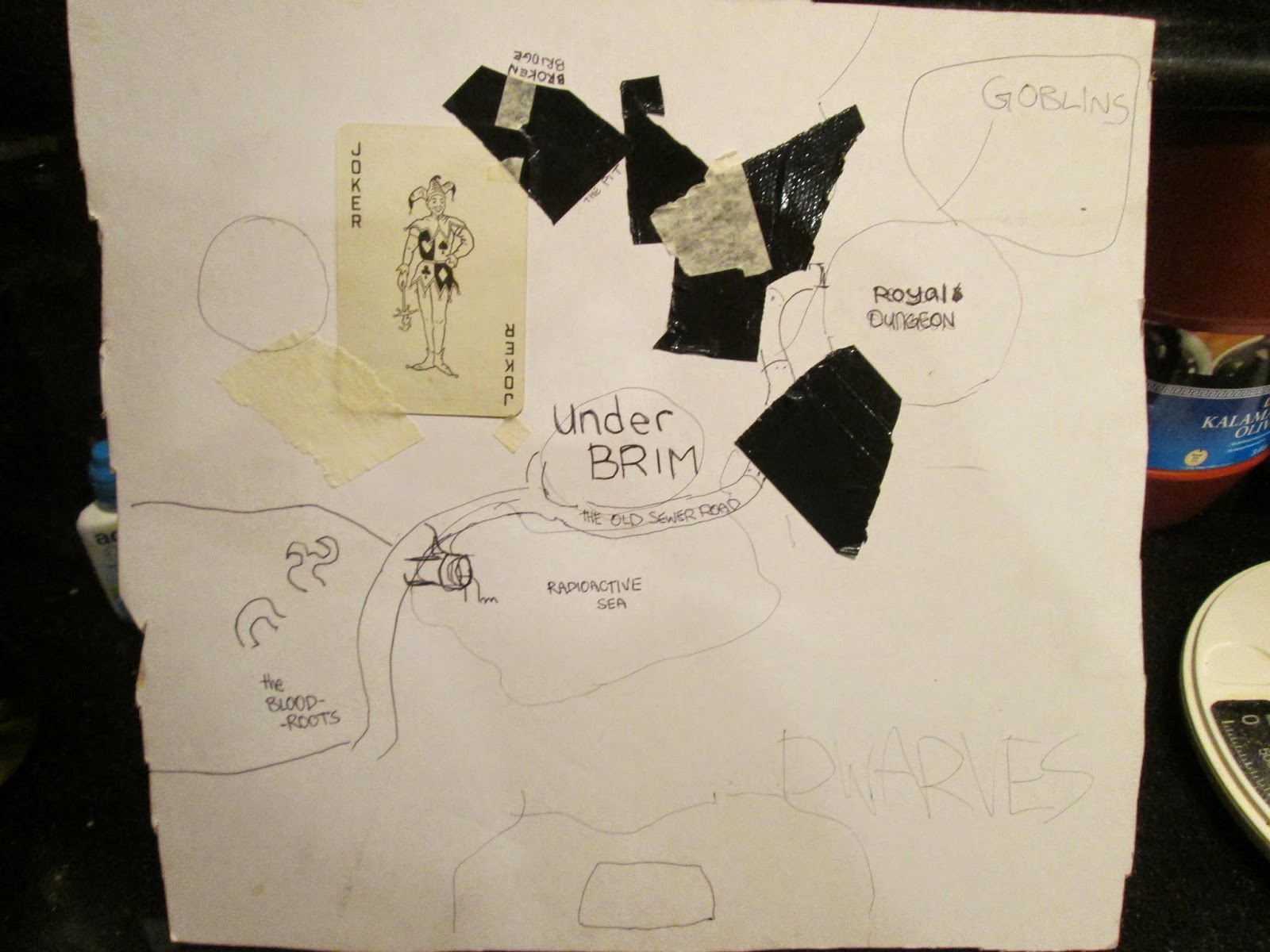
Brimhold, Level 2


The river is clotted with ash from the Megavolcano at its source. The Ash Quarry filters it. The ash itself is prized for its mystical qualities.

There was once a great god who ruled over everything. He was burnt into cinders and destroyed. Each cinder became a tiny god. They thrive in ramshackle shrines in the Cinder House.

Who is Malarkus?  I guess he's a ghost the size of a building.

The Moon Pool is the place of my goddess. You chuck pebbles into the pool, and divine her advice from the shape the moon makes in the ripples.


Brimhold


Matt Rundle and Matt Groves made this map for Matt's campaign. Click to make it bigger.

Grisby's Great Terrarium: Top left, in the walled-off goblin district. The goblins are making it. No-one knows why.

Lord Jub: Near royal keep. The first king who settled the town released his pet goldfish into the river. The fish has grown with the town. Legends say it cannot die while the town stands - or the town cannot be destroyed while it lives - one or the other.

Somerset Arena: Cheapside and Uptown unite around this boundary-spanning blood bowl. Uptown folks have box seats up their end, while the Cheapside mob set up ladders and ramshackle shanty seats around the other. In the center of the arena grows the Blood Oak. It looks normal, except that its roots have long been dyed deep red. They say some terrible disaster while strike the town if the Blood Oak ever goes unfed.

Don't reward your players for role-playing.

In old RPG's, there's no reason to role-play. It doesn't give you any kind of in-game advantage or mechanical bonus. Many new-school RPG's have tried to fix this by giving out Checks,* Action Points, or - in 5th edition - Inspiration Points as a mechanical reward for role-playing. I think this is a bad idea, because extrinsic rewards destroy the intrinsic fun of role-playing.


Mario's jump is Intrinsically fun. This means you don't need to be rewarded for it: the activity is rewarding in itself. You could put Mario in an empty room, and leaping three times his body height with a "Broing!" would still be fun.  It's so great that we ended up putting it into almost every video game ever made. Whether you're playing a robot or a detective or a badger, if you can't press a button to leap at least half their height it feels like you've lost a limb.

This is just like Role-playing. There's no reason why you can't play original D&D as an abstract tactics game without ever pretending to be your character. Role-playing is still so intrinsically fun that everybody did it and we named the whole genre after it.

Now, imagine if Mario's jump was shitty. He just floats up and down with a sad "Bworp". To compensate, we give you a gold coin every time you jump. We've just made it Extrinsically fun. The fun now comes from the reward you get for performing the activity, not the inherent fun of the activity itself. You no longer jump just for the joy of it: you are jumping for the reward. When you give people points for role-playing, you're hoping to motivate them with an extrinsic reward.


I have an intrinsic dislike of extrinsic rewards. The game should be inherently fun: you shouldn't have to convince me to keep playing by giving me in-game lollies. I don't need to play games to get the experience of completing a boring activity for the reward, I get enough of that in real life. If you play video games, though, I'm sure you can think of plenty of games where you do just that. External rewards are so powerful that they've even made deliberately bad games like Cow Clicker successful.

Of course you may be thinking - what if we keep Mario's jump as the fun and exciting mechanic it is, but ALSO give you a gold coin every time you do it? This is the reasoning behind giving players points when they role-play. Intrinsic fun AND extrinsic fun, that must combine to make the game more fun than ever, right? 

Well, research has found that's not quite true. In the words of this literature review: "...expected tangible rewards made contingent upon doing, completing, or excelling at an interesting activity undermine intrinsic motivation for that activity." Giving out an extrinsic reward destroys the intrinsic fun. When you're rewarded for performing an activity you enjoy, you lose interest in performing it for it's own sake. You stop jumping for joy and start jumping only for the reward.

Also, check out this summation of the effect of extrinsic motivations on children. If you take an activity that children enjoy, reward them for it, then take that reward away, they may stop doing it altogether. External rewards are so powerful that they lead kids to lose track of what they enjoyed about the activity in the first place. Parents take note.

Now, I don't believe external rewards are evil. Most of us give out XP for going on adventures, and even Mario gives you points for jumping on Goombas. The difference is that these mechanics are there to give a sense of progression, while rewarding people for roleplaying is intended as a way to change player behavior.


In D&D, you start as a scrawny guy killing rats, and playing that way makes you into a king killing dragons. In Call of Cthulhu, you start as a rich, sane and well-adjusted guy and play until you become homeless and insane. They move in opposite directions, but both mechanics aren't so much there to reward you as they are to make sure that the game you play tomorrow is different from the game you played today. Neither exists to make the players do anything they weren't already going to do. You could still undermine the intrinsic fun of adventuring if you overdo it with constant rewards and treasure, but I don't think it's an inherent problem with XP.


In comparison, I always see role-playing reward mechanics recommended as a way to change how people play. You do it to make them role-play more. It's a type of behavioral conditioning, a skinner box made to get your friends to behave the way you want. You shouldn't need this. If you have a player who's shy and doesn't role-play much, why use a passive-aggressive rewards system to punish them for playing that way? If you dislike the way someone plays, why not just talk to them about it? Extrinsic rewards are just going to make them enjoy role-playing even less than they did in the first place.


An interesting part of that first literature review is that verbal rewards actually enhanced intrinsic motivation. Do you laugh at your players jokes? Do you say "Well done," when they carry out a clever plan? Do you say "That was awesome," when they perform some dramatic role-playing? Then congratulations, you're already externally rewarding their behavior in the best way possible.** You don't need to give them imaginary points to try and control how they act at the table.

Role-playing is one of the most intrinsically fun things you can do at a table. If your players don't want to do it for whatever reason, I think the last thing you should do about that is layer an extrinsic rewards system over it.

*This used to say "awesome points" instead of "checks". I edited it because I realized that I don't have a problem with the awesome point mechanic from Old School Hack. It's a mechanic that lets anyone give a player XP for any reason, rather than an attempt to encourage role-playing. The Check mechanic from Torchbearer - where you need to role-play your character's flaws in order to make camp - is more like what I'm talking about.

**The paper seemed to suggest that controlling verbal feedback still diminished intrinsic motivation. That is, saying things that attempted to control their behavior (eg, "You should keep up the good work,") - were worse than things that just gave information on how well they were doing (eg, "Nice one."). What I've taken from all this is that you should just chill out and avoid trying to control your players.

The research I've done is of course haphazard. If anyone has an issue with the conclusions I've drawn, bring it up.